Categories
cooking korean food

Korean Food: Making Kimchi

As mentioned in a previous blog post (“Korean Food: My Love Love Relationship”), I am a fan of Korean food. I like eating it, I like talking about it, and I like making it. I find that all of the above are especially meaningful to me as a way to explore and grow my connection to my Korean roots.

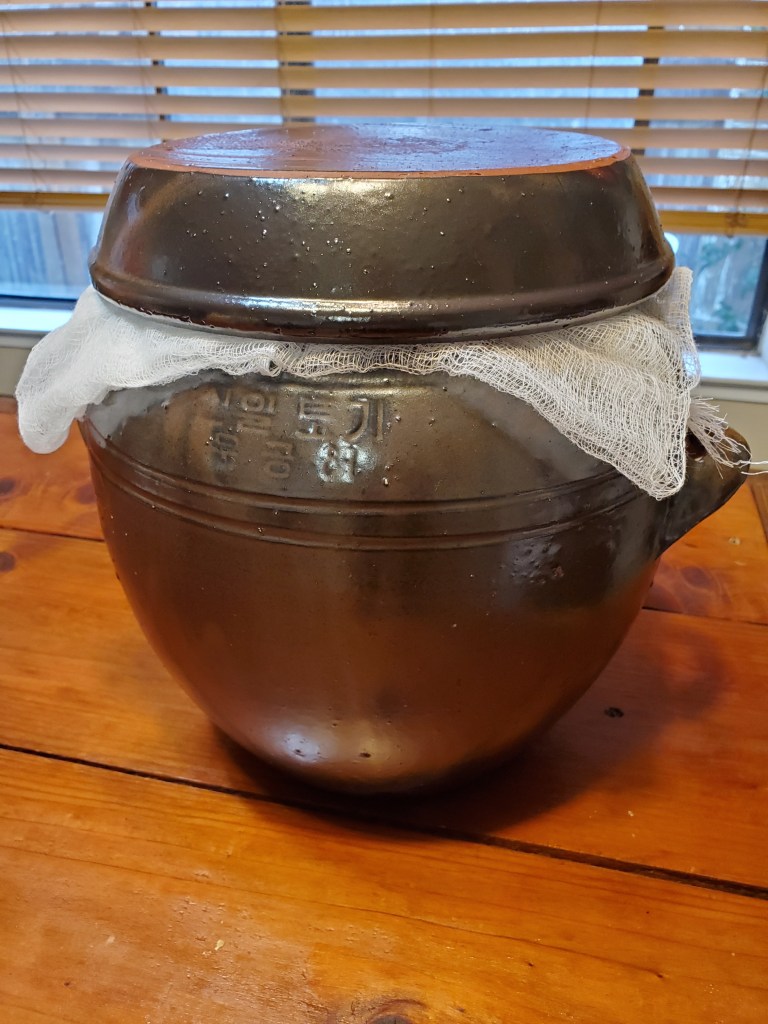
Spicy, fermented napa cabbage (commonly referred to as “kimchi” 김치) is arguably as Korean of a food as you can find. It is the national dish of both South and North Korea. It’s a staple of the Korean diet, coming in many varieties, and eaten numerous ways including by itself or as an essential ingredient in many soups and stews. Traditionally, kimchi was stored in large, earthenware, lidded pots (called “ong-gi” 옹기), often buried underground to prevent being frozen during cold months or to slow down the fermentation during warm months. Outside of the common napa cabbage version (actually “baechu-kimchi” 배추김치), there are hundreds of varieties of kimchi (the term itself referring to fermented vegetables). You could theoretically make kimchi out of just about any vegetable! The flavors and textures of each vary, and even the same variations of kimchi can look, smell, and taste differently depending on the maker, ingredients, age, and a number of other factors.

For this post, I’m going to specifically focus on sharing one of my experiences making baechu-kimchi. If you desire to make your own, there are numerous recipes online and in print. You could even find your own Korean friend (typically women were expected to make kimchi and many women over 50 continue this practice) and ask to join them in making kimchi. For ease, I’m going to include a few recommendations of recipes that I personally like for making napa cabbage kimchi (baechu-kimchi 배추김치) below. However, there are many recipes out there, so please explore on your own and find some that you like!

List of Napa Cabbage Kimchi Recipes (in no particular order):
1) https://www.maangchi.com/recipe/tongbaechu-kimchi
2) https://www.koreanbapsang.com/baechu-kimchi-napa-cabbage-kimchi/
3) http://crazykoreancooking.com/recipe/kimchi-spicy-pickled-cabbage

As a note, before you start making your own kimchi I highly suggest putting your hair up/back if you have long hair and wearing a pair of good rubber gloves!

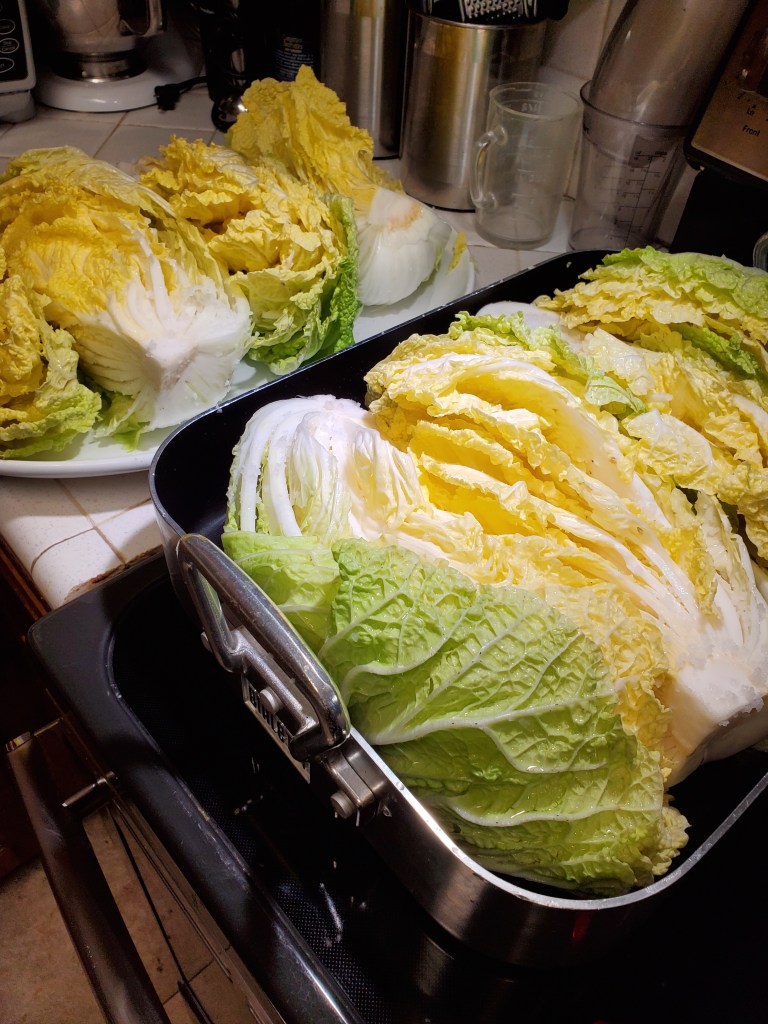
Early Stage: Halving and salting napa cabbage!
Early Stage: Napa cabbage in the process of brining
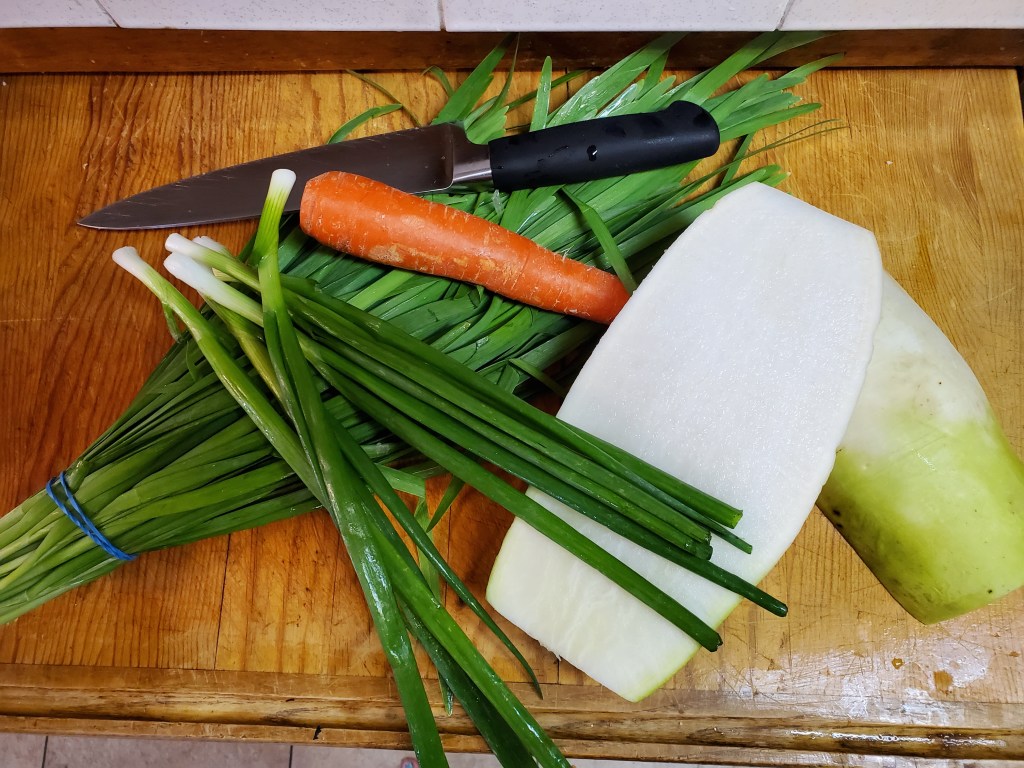
Early Stage: Chopping and slicing additional fresh ingredients (pictured here: radish, green onion, scallion, carrot)
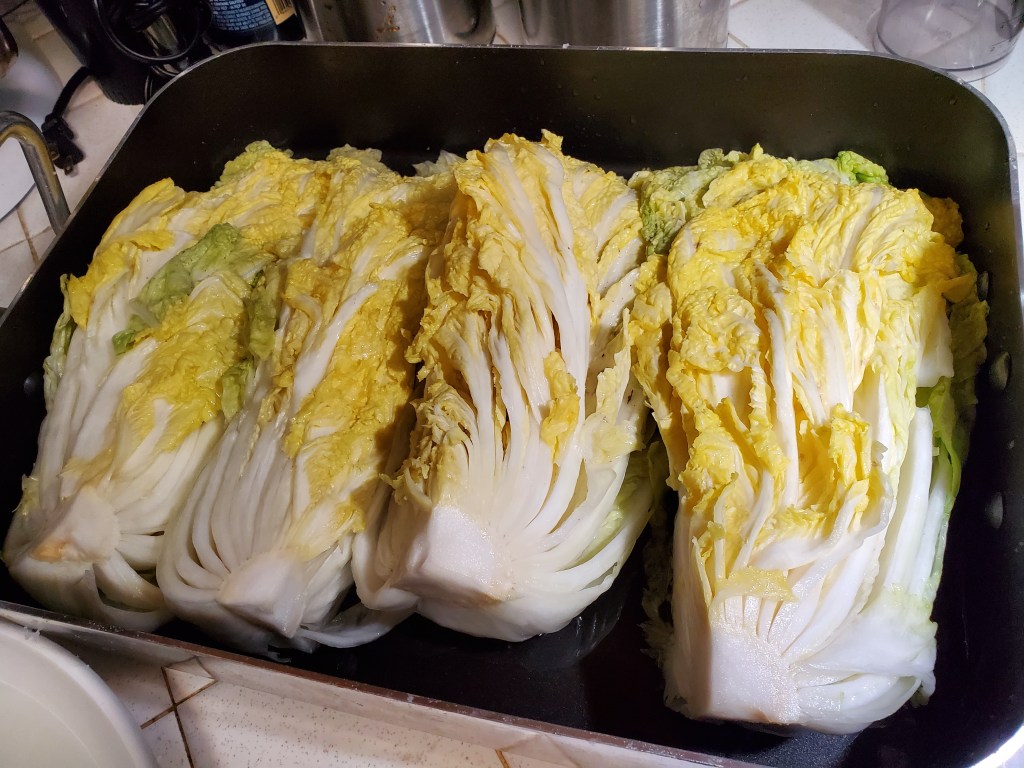
Medium Stage: Brined napa cabbage
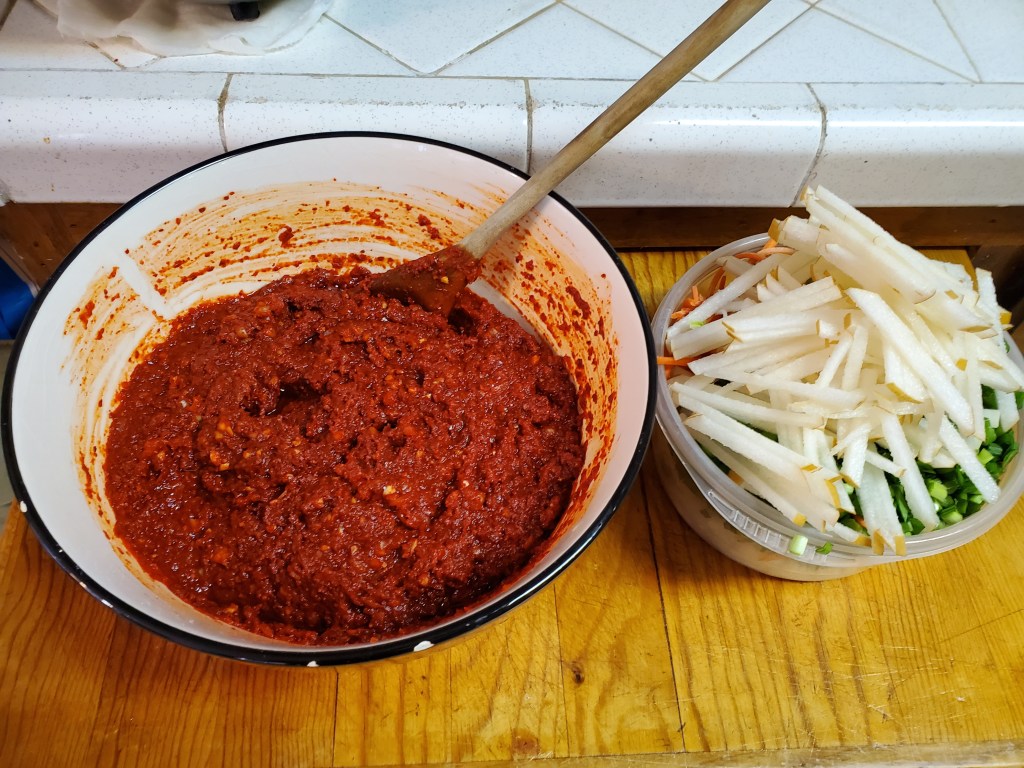
Medium Stage: Additional vegetables and chili paste complete
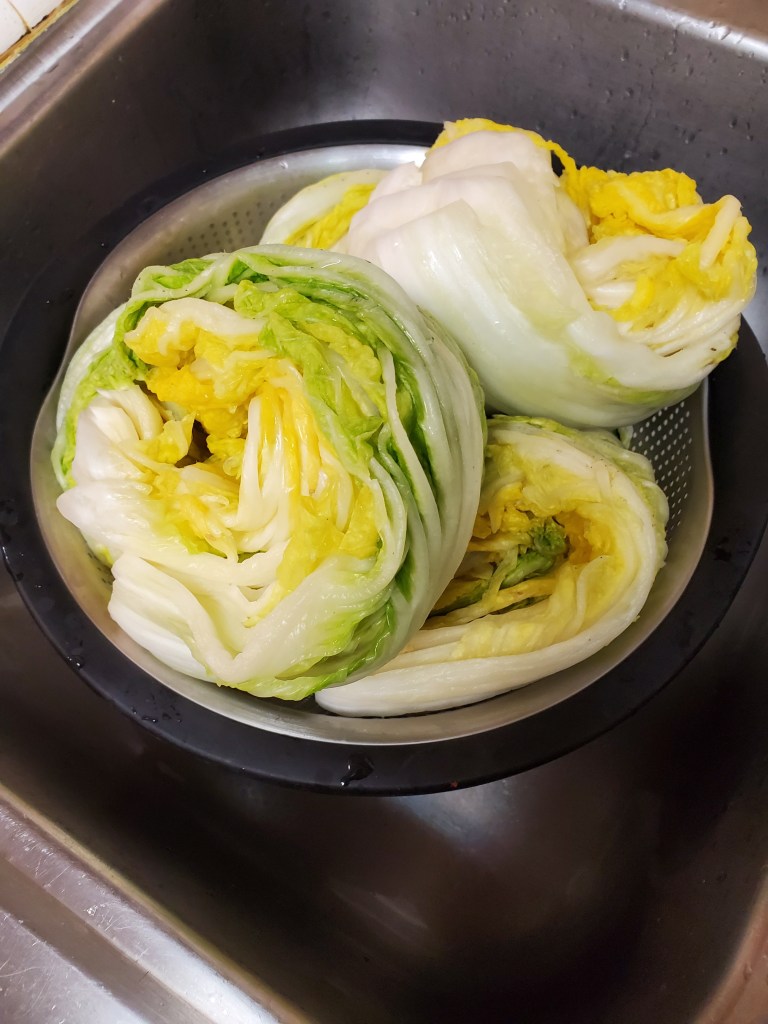
Medium Stage: Rinse, and drain your brined napa cabbage
End Stage: Apply the extra ingredients to your napa cabbage
End Stage: Stack your baechu-kimchi rolls in a container (pictured here: my onggi)
End Stage: Cover and let the fermentation process begin

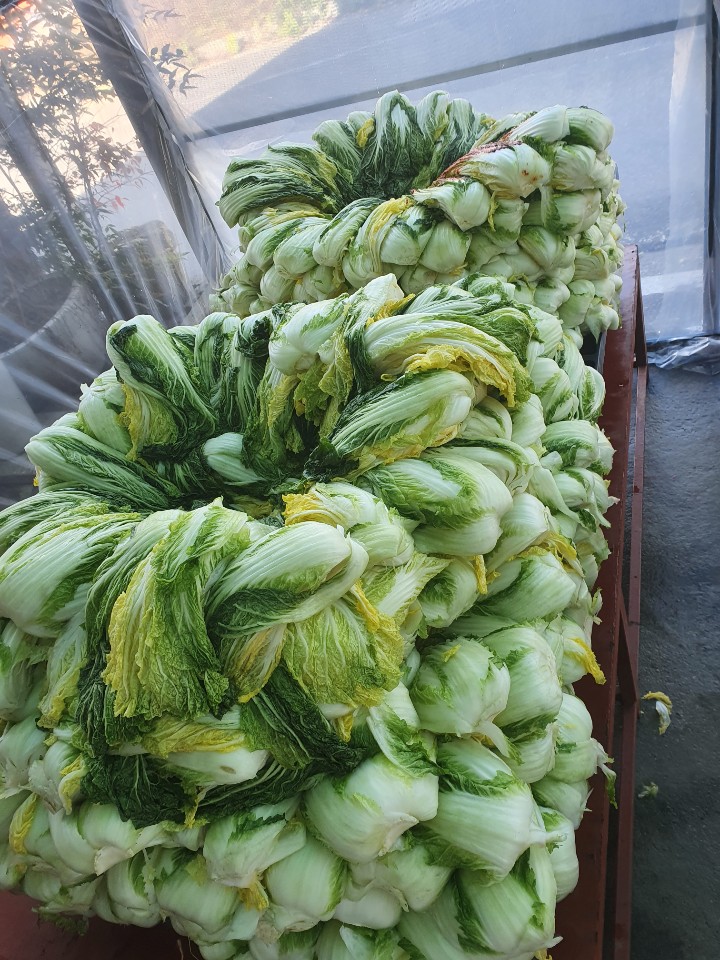
As a little added bonus to this post, there is a specific event in the winter called Gimjang (김장). Gimjang is the traditional process of preparing and storing kimchi for the winter. Gimjang yields large quantities of kimchi as it was meant to provide food throughout the winter. Often it is a highly labor-intensive task that communities participate in, families, extended relatives, neighbors. This past winter, my 엄마 (eom-ma meaning mom, in this case my birth/bio mom) sent me photos of my bio-family’s gimjang.

Napa cabbage for gimjang
Paste/sauce for kimchi
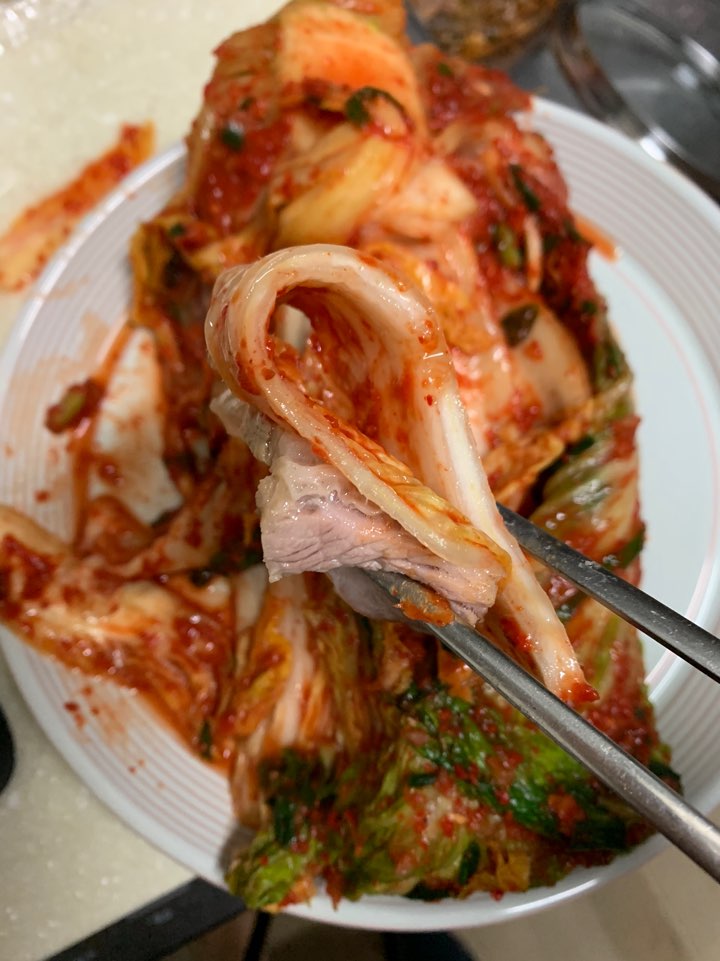
They ate pork suyuk, kimchi, and drank makgeolli during gimjang! Delicious!

Anyway, I hope that you enjoyed this post about making traditional, napa cabbage kimchi! I love 배추 김치 and highly recommend giving it a try if you have never eaten it before. Additional points if you decide you’d like to try making it yourself! It’s an interesting process, yields delicious results, and, to me anyway, helps me to feel closer to Korea and being Korean.

사랑해요! (I love you)! ❤

Categories
korean food

Korean Food: My Love Love Relationship

I remember being introduced to Korean food very early as a KAD living in Minnesota, USA. My parents sent me to Korean Culture Camp (https://kccmn.org/) every year for a number of years. While it was only a week-long opportunity to absorb Korean culture, being surrounded by KADs and Koreans, I distinctly recall my love of Korean food. Korean snacks were always on display and available for purchase, we talked about Korean food, and were served Korean meals every day.

I remember the amazing smells of Korean food wafting throughout the campus. Kimchi, japchae, bulgogi, and steamed rice were among my favorites.

When not in camp, my parents found ways to make sure that I got Korean food, on occasion, at home. In life, I’d sometimes come across Korean friends or acquaintances, even befriending and dating a Korean-American with a traditional Korean family. These occasional meetings often resulted in families automatically identifying me as a Korean and would usually lead to their giving me home-cooked Korean meals.

When I moved to Seattle, as a young adult, I suddenly had an increase in Korean options with numerous Korean shops, bars, 노래방 (Korean karaoke), restaurants, and 고기집 (Korean bbq) nearby. Eating Korean food became standard. Inspired, and already a regular cook and baker, I started making Korean food for myself.

When I moved away from Seattle, after over 11 years of living there, I lost my community of friends. Something I’d not realized I’d also lose was the community of Koreans and Korean culture I’d had, in some way, as a mainstay throughout my life. This was a startling and difficult loss for me. It felt very much like I had a part of my identity cut-off, with nobody around who recognized my Korean-ness or that Korean-ness in general was a thing.

Aside from personally loving Korean food, and associating it with my identity, my experiences up until that point had also shown me how important food is to Koreans as a major part of their, our, culture. Korean meals are a communal and social experience. You eat meals with friends, family, business partners, peers. You often drink, and when you drink you eat. In my love, comfort, and enjoyment of Korean food I had been unknowingly doing a very Korean thing. As a Korean-adoptee, I highly recommend finding ways to experience Korean food if you can. Even better, if you can experience it with good company.

Fast forward a little bit, I’m 4.5 years out of living in Seattle. I now live in California, with more Koreans (and Korean restaurants, 노래방, and even an H-Mart) around. My Korean community and a sense of being a part of the Korean culture is still missing. Especially as a KAD, it’s hard to find, and be accepted into, Korean communities and culture without “an in”. However, my love of Korean food and cooking has not diminished. If anything, I am more invested now than I used to be in making Korean food a normal, even daily, part of my life.

I’ll be writing future blog postings about my Korean cooking adventures, as well as sharing pics of Korean foods and drinks that I enjoy on my Instagram account (@learningtobekorean). This post, however, is just a little personal overview of my relationship (a 100% love love one) with Korean food.

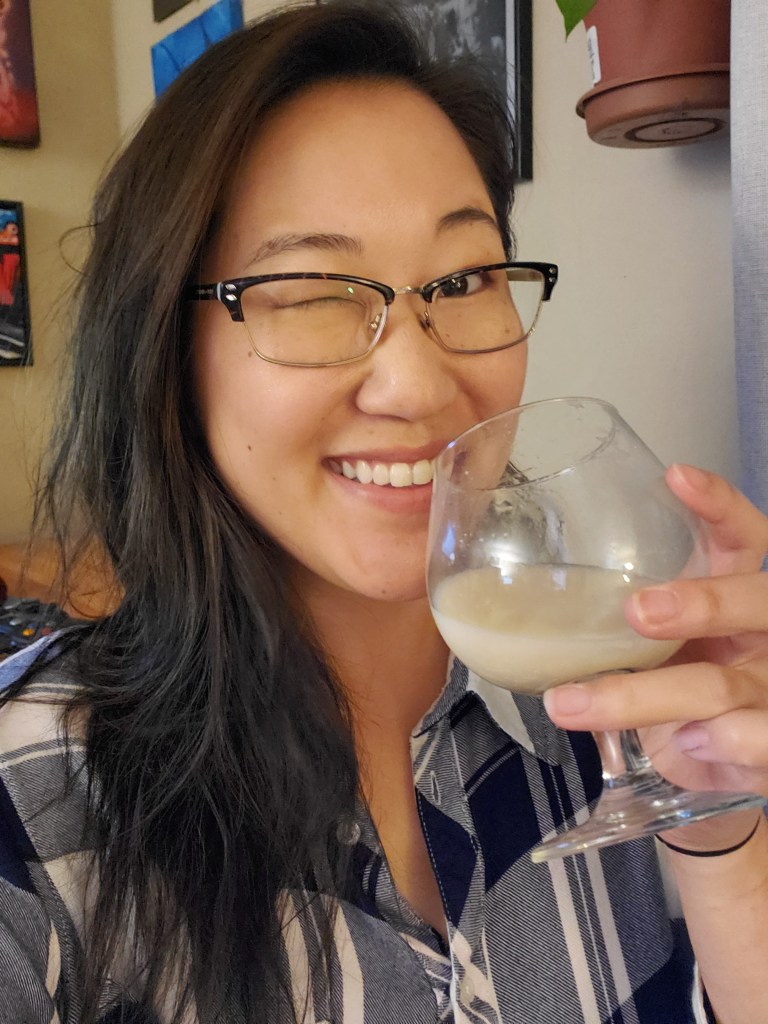
Enjoying some home-made Makgeolli (막걸리 – raw rice wine)

For anyone new to Korean food, here are some dishes that I suggest trying out that seem like a nice place to start. Of course, there are numerous dishes to seek out once you get started! Don’t forget to get steamed white rice (밥 – bap), fermented napa cabbage (배추김치 – kimchi), and plenty of side dishes (반찬 – banchan) with every meal.

  • Bulgogi (불고기) – This literally means “fire meat”, but is not at all spicy. Bulgogi is thin, marinated slices of meat (usually beef) grilled over fire. It became popular in Seoul after refugees from Pyongan moved there after liberation from Japanese forced occupation in 1945. I find this dish to be comforting, filling, and a little sweet/savory.
  • Japchae (잡채) – This means “mixed vegetable” and is a sweet/savory stir-fried dish. It is not spicy. It consists of glass noodles, vegetables, and optional meat. It is most commonly a side dish, but can easily serve as a meal. It used to be a royal dish, but is now a highly popular celebration dish, usually served during holidays or other special occasions.
  • Bibimbap (비빔밥) – This means “mixed rice” and is a popular meal. Bibimbap is a very customizable dish, but typically includes rice, egg, seaweed, vegetables, and gochujang (chili pepper paste). Meat is optional. It is not spicy, but can be depending on your customizations and amount of added gochujang. It stems from early, rural Koreans mixing rice with leftover vegetables in a bowl. At it’s root, bibimap is a very accessible dish.
  • Chikin (치킨) – This is a Korean reference to American fried “chicken”. It comes in a wide variety of styles and flavors, including highly spicy versions. It is often a meal, but can be an appetizer, anju (안주 – bar food), or even a snack. Korean fried chicken began to become prevalent during the Korean war when Americans occupied the area and began placing stalls that sold it, as well as other soul/comfort foods. The Korean style of frying chicken differs from the American style in that it employs a different frying technique that renders out much of the fat from the skin, creating a thin, crackly crust. I personally find it delicious and enjoy it as a treat, sometimes with a crisp Korean beer and banchan.
  • Samgyeopsal-gui (삼겹살구이) – This means “three layer flesh – grilled”. It is essentially grilled pork belly and is often served with sauce, garlic, onions, scallions, pickled vegetables, and wrapped in a lettuce or perilla leaf. It is highly popular in Korea and is commonly eaten along with shots of soju. It can be its own meal. This is a fantastic group meal to enjoy with friends or family.

I hope that you try out some Korean cuisine if you have not yet had the chance. I personally find it comforting and delicious. If nothing else, though, it’s a nice way to bring Korean culture into your life.

사랑해요, KADs! (I love you, KADs), ❤

Categories
how to language

How To: Read, Speak and Write in Korean

For many KADs, the inability to read or speak Korean is a leading cause of dissatisfaction when traveling to Korea or engaging with Korean-speaking persons in their country of adoption. Additionally, not being able to read, speak, or at least understand Korean can cause difficulties if a Korean-adoptee reunites with their biological family… whom may not be able to read, speak, or understand English (or whatever language is native to the country that the adoptee grew up in).

I know that for myself, being unable to communicate in Korean with other Koreans, or being unable to understand what is being said, has been a long-standing point of sadness, embarrassment, and frustration. I have been othered by Korean-speakers (both native Koreans, Korean-Americans who grew up with Korean families, white or non-Asian BIPOC who are fans of K-culture). I’ve been told that I’m “less Korean” or “less Asian” than completely non-Asian and non-Korean people, which has been painful for me (especially when I was a younger person more impacted by these types of interactions). “You’re a banana”, “You’re not a real Korean”, “You’re the whitest person I know”, “You’re whiter than I am”, “You are a bad Korean”, “I don’t even think of you as an Asian or Korean”, “You should know how to speak the language of your people”, “It’s so sad that you’ve given up on your culture” are common phrases I’ve heard throughout my life. Based on conversations I’ve had with other Korean-adoptees, these are very common things that we’ve been told. Constantly being told these things can impact our feelings of being “less-than”. It can also make it scary to try to learn the language, especially since there’s a sense of “this should be so easy for me… I’m Korean” and one does not want to fail.

According to an article by NCBI (https://www.ncbi.nlm.nih.gov/pmc/articles/PMC5514759/), “Dutch adults who, as international adoptees, had heard Korean early in life but had forgotten it learned to identify an unfamiliar three-way Korean consonant distinction significantly faster than controls without such experience. Even adoptees who had been adopted at 3–5 mo of age showed the learning advantage.” Many Korean-adoptees fall within or older than this age range when adopted out-of-country. What does this mean? Well, to me I take it as a boon in my journey to learn Korean and to “be” Korean. There’s some baked in Korean-ness that I can celebrate. At one point, my mind recognized Korean as my native language. So, with hard work and diligence, I can grow those skills with a potential slight advantage compared to other non-Korean learners.

Before I move on, please note that I consider my adoptive family to be my family. They are the people who raised me, cared for me, loved me, supported me, continue to think of me and want me to be happy and healthy. I refer to them as my family both personally and in my blog when I’m talking about them as individuals or as units. Calling my Mom, Dad, brother, cousins, aunts/uncles, grandparents etc. my “adoptive” anything feels just as wrong to me as when I am called an “adopted” anything by them. Instead, you will likely see me use a descriptor of “bio”, “birth”, or “b” when I refer to my genetically-related family… . I know that there are many adoptees who feel differently about this topic, whether completely opposite or neutral. there are also adoptees who use the same language and reasoning as I do when referring to family. So, please just note that this is how I choose to speak. I do not speak for or judge other adoptees for saying, thinking, or doing whatever is right for them.

My parents did their best at raising me to have Korean experiences within their means. I went to Korean Culture Camp (https://kccmn.org/) as a child, where I was surrounded by Korean-adoptees and Korean culture, including language lessons. I took Taekwondo into my teens. I had hanboks, I ate kimchi, I had a Korean doll, Korean story-books, and my parents made sure that I was aware of my Korean heritage. Very early on they told me the Korean name that they were told was my name during the adoption process… and I went by that name henceforth with my family and extended community. My family calls me by my Korean name to this day, although like many Asian-immigrants in the United States I use my American name elsewhere.

As a young adult, I met and made a number of Korean friends (both native immigrants or generationally Korean-American) after moving to Seattle, WA for college. I consider myself to be close friends with some of them still, over a decade and a half later. The experiences I had with them, the other Koreans I met through them, the cultural expectations they brought, conversations they held in Korean, nights out drinking and K-bars and restaurants, going to K-BBQ, K-Karaoke, watching and listening to K-pop music and TV shows was very impactful for me as a Korean-adoptee. It was my first time seeing what felt like real, honest Korean-culture and I loved it, felt enriched by it, and like I was engaging with something that was a part of my true self. However, I also felt like a faker, observer, outsider, and like an American… not like one of them. I acted wrong and couldn’t communicate in the language. To me, when other Korean-adoptees talk about their negative experiences visiting Korea for the first time, I reflect back to my first experiences being around this type of Korean culture. Something that stands out is the lack of being able to communicate.

Despite the advantages I had growing up with a family that supported and sought opportunities for me to experience Korean-ness, and living in Seattle where I had a persistent relationship with Koreans and Korean culture, I am not a competent Korean communicator, yet. This is something that I decided, in my mid-30s, during the summer of 2020 amidst the Covid-19 pandemic, that I wanted to rectify. My wish to learn the Korean language preceded my wish to start a birth search and is something I have thought about doing since I was a young adult. I was too scared and embarrassed, worried about failure, and impacted by the negative experiences I’d had regarding other’s opinions of my Korean-ness. I still have these thoughts, which I recognize and work on. But, I’ve also matured and realize that true failure is never trying, I need to focus on being happy and able to live with myself, and that all of those people knew nothing of me, my struggles, or my tenacity nor did they care about me or my wellbeing. I’ve only been at it for 8 or 9 months. So, please keep that in mind throughout this “How To” post… I am just a Beginner, maybe like you. 🙂

Step 1: Set a Goal and Timeline

Once I decided I wanted to take the plunge and truly invest in learning Korean, I set a goal for myself. Because I work a full-time job, and also run a side-business, I wanted to make sure that my goals were realistic and achievable. Decide for yourself what this looks like based on your needs and lifestyle.

For me, in one year I wanted to be able to:

1) Memorize and know the Korean alphabet
2) Read Han-gul (Korean writing)
3) Type and hand-write Han-gul with relative ease
4) Have a three-minute conversation in Han-guk-eo (Korean language) using simple phrases and correct grammar with a native-Korean speaker
5) Memorize and sing a Korean song
6) EDIT: After my birth search yielded reunion with my bio-mom, I added a more challenging bonus goal of being able to write simple letters to her in Han-gul with little to no aid of a human translator. Using translation services (like an English-Korean dictionary) is acceptable.

Step 2: Set Parameters for Yourself

Once I decided on achievable, measurable goals and a timeline for myself, I realized that I needed to find ways to hold myself accountable (i.e. steps to meet my goal). I decided that I could promise myself to practice Korean every day for a year. I did not set a minimum amount of practice time per day, and have spent anywhere from 15 minutes to multiple hours on any given day working on Korean.

I also noted the self-created challenges I’d face. Being/appearing successful, not being/doing something wrong, and being/appearing fully self-reliant and independent (i.e. never needing help) are parts of who I am (many of which are common characteristics amongst those whom experienced abandonment and a lack of human interaction/safety/security as infants or children). All of these characteristics can be highly detrimental to the learning process, especially with something as complex as communication and language. So, just as I identified actionable steps to meet my learning goal within my 1 year timeline, I also identified the “soft” or personal challenges I’d have to overcome to be successful at meeting my goal. Accept failure, accept being publicly bad at something, accept being wrong, accept doing things wrong, accept needing help.

Your own parameters may differ from mine, and that’s totally understandable! I do recommend completing Step 2 regardless of how different it might look for you because I feel like if you’ve set a goal, it makes sense to determine ways to achieve it.

Step 3: Choose your Learning Tools!

When I was a teenager I won a scholarship to travel to Germany as an exchange student. Up to that point I’d taken German classes in school for a few years. Despite my schooling, I believe the greatest leap I made in my German language learning (comprehension, pronunciation, reading, speaking etc). was during my time living in Germany. That said, I doubt I would have been in as good of a place to live there or learn had I not spent time learning even the basics of the language before my exchange.

As a note, everyone has a different style of learning. I tend to prefer visual learning methods (reading, writing, taking notes and reviewing). I find auditory only learning to pretty much fly right into one ear and out the other. However, I recognize the need for auditory, vocal, and hands-on practice when learning a new language. I believe there are likely tools out there for every different style of learner.

For me, I decided to approach Korean similarly to how I learned German, minus taking physical or academic courses. (It’s not that I don’t believe in taking classes… in fact, I’d very much like to do so and think it would be helpful. However, I would like to do that when I can physically engage in said courses… likely post-Covid19 era whenever/whatever that might be. Possible options that I’m looking into include moving to Korea to take summer courses or full academic instruction, language courses in my area, and/or volunteering at Korean community centers in my area to engage with more Koreans). I realized that I like reading/seeing information, and engaging in visual practice with the aid of auditory or vocal reinforcement so looked for tools that seemed fitting. I also decided that I would be willing to pay a somewhat significant sum (in the hundreds of dollars) at the beginning of my language journey to give myself as many tools and I could.

My Korean Learning Tools to Date:

a) Duo-Lingo Pro – I use the Android app. I work my way through at least 2-3 mini-modules per day. It’s not perfect, and some folks feel that it doesn’t teach things the “right” way. However, I’ve found it to be a low-maintenance way to do daily practice that includes vocabulary, grammar, written, and vocal means. I’m currently on a 269 day streak.
b) 90 Day Korean (https://www.90daykorean.com/) – This is a language program (with paid options) that is done entirely online. It was co-founded by an American who moved to South Korea and is tailored to those with similar backgrounds with the goal of learning how to carry conversations on a 90 day plan. There is an active community forum, monthly online group language practice, a native-Korean speaking “coach”, and a linearly laid out learning plan (4, 13-week modules with 100+ lessons per module and 20+ quizzes per module). I have been much slower with this program than 90 days, taking my time to work my way through as it suits my availability. I think this is a great resource and would recommend it to anyone who can afford it. Quite honestly, I think I underutilize it and am working to work it in as a higher-priority resource.
c) Talk To Me in Korean (https://talktomeinkorean.com/) – This is another language program (with paid options) that is done entirely online. I have not subscribed to this program. However, I do listen to their free Podcasts on Spotify which houses at least 10 levels of Korean language lessons. I am having a great time with this as an auditory resource. I find that they are good about using realistic examples of who Korean natives talk and provide insights into the culture each episode. Each lesson is very approachable and does not feel overwhelming… they’re small, digestible chunks.
d) Naver Dictionary (https://ko.dict.naver.com/) & Papago (https://papago.naver.com/) – This is an online dictionary that includes English and Korean. There is also a phone app which I highly recommend. Papago is a Naver-supported translator.
e) Kakao Talk – This is a popular social messaging app in Korea. It has text and video options. There are a number of language learning groups on Kakao that you can join where folks text in Hangul.
f) Korean Friend(s) – This is a fantastic resource if you have the option and sounds like what it is. Make a Korean friend. Text them in Korean, call them to talk in Korean, ask them to be merciless in correcting you. I am lucky to have a native-Korean friend who video chats with me once-a-week. She was trained as an English teacher in Korea and moved to the USA a few years ago for personal reasons. She sends me YouTube videos of Korean lessons she puts together (check out “Ms. Jun’s Korean Class” at https://www.youtube.com/channel/UCLINC3ab5z1Bsl3KvONaKwA), PowerPoints, tells me about Korean culture and history, and shares K-pop songs and TV shows with me to watch “together” and discuss. We don’t always talk about Korean stuff or focus on Korean learning (we’re friends, after all, and I like talking to her just for her). But, when we do, the lessons are extremely valuable.
g) Books – This can refer to a number of things and is entirely up to you. I purchased “Korean Grammar in Use” (Beginner, Intermediate, Advanced) as a supplement to my other learning tools. In addition, I purchased a number of children’s books in Korean like “Where’s Halmoni?” because they’re written for those with low comprehension and easy vocabulary.
h) Korean Language on your Devices – I highly recommend setting up your computer and your cell phone to support both English and Korean language. This way, you can text and type in Korean. Additionally, printing out or buying a English-Korean keyboard key sheet is helpful so that you can start building up muscle memory for typing in Hangul.
i) Music, TV and Other Media – Interested in learning more about Korean language and culture? Start listening to Korean music, watching Korean tv shows and movies (in Korean, of course), and consuming other Korean media (find Korean magazines or publications that you like). I don’t have much of a guide to this option… I just searched until I found things that I like! BTS and Blackpink might be very popular, or K-dramas like “It’s okay to not be okay”, but if you don’t enjoy them then you’ll likely not get as much out of it than you would finding something that you really do like. Thankfully, with K-culture/Hallyu (한류) continuing to be so prevalent, it’s not hard to find plenty of stuff to watch, listen to, or read!
j) Flash Cards – Vocabulary is hard for me. There are so many words and I often forget them or mix them up. I started making physical flash cards to practice vocabulary, but that turned out to be super challenging to keep up with simply because there are so many words! Therefore, I moved over to an app called “AnkiDroid”. Essentially, this is a digital flash card program with time tracking for how many cards you study in a day and for how long. You can download flash cards that meet your needs (I like anything by Evita) and work your way through them.
k) Hints – If you’re like me, vocabulary is tough, you don’t have the chance to use Korean every day in real-person conversations to help things stick, and you have a hard time making connections between words and their physical objects, finding ways to sneak in daily “hints” around your living space can be super helpful. I like to use post-its, write the words for items around the house in Korean, and stick the post-it on the item(s) so that I am always reminded of what an item is in Korean.

Step 4: Stick to It
Not really a “step” like Steps 1-3, but a worthy tagline. Learning a new language can be hard. On top of it, life often gets in the way. Sometimes you might find yourself short of time, money, patience, resources, or feeling like you’re making very little progress. That’s okay. If you want it badly enough, find ways to keep sticking it out. Maybe it means changing out certain tools for other ones or changing your learning schedule. Be kind to yourself. Keep working.

Well, that’s all that I have for my “How To: Read, Speak, and Write in Korean” post for now. I’ll try to update this post if I find other useful tools as I continue my language learning. If you have any cool ideas or resources that are working, or have worked, for you… please don’t hesitate to share in the comments section!

독서 감사해요! 사랑해요! (Thanks for reading. I love you!) ❤

Categories
birth search how to

How To: Start a Birth Family Search

I decided to start my birth family search in June of 2020 at the age of 33 (34 in Korean calendar). There are very few, if any, resources for how to go about this process as an international adoptee. If you are lucky enough to know an international (Korean) adoptee whom has gone through the process and is willing to share their experience with you, it can be helpful. I proceeded with my birth search without the knowledge or support from others. My hope is, in sharing my experience and the steps I took to start my birth family search, that you (or the KAD in your life) may find some sort of ease in your own search.

Please keep in mind that each search is different, just like each KAD and each KAD’s journey is different. The information and circumstances of our abandonment varies as do the routes we were taken on to get to our adoptive homes. This is just my personal experience.

Step 1: Decision to Open a Search

This seems like a no-duh, but for many folks the decision to open a search is intense in some way. Often time there’s deep seeded resentment toward birth families for being abandoned. Maybe there’s fear of rejection or fear that nobody will answer the search. There may be fear of anger, reproach, or lack of support from your adoptive family, direct family (i.e. spouse, children) and your friends. Maybe you’re happy with your adoptive life and just haven’t cared to start a search. Perhaps you wanted to take the leap but were not ready until now. Maybe you simply don’t know how. Rest assured, these are all understandable and valid reasons for not searching and should not be disregarded or delegitimized.

For me, I’d thought in spurts about my birth family throughout my life post-adoption. But, for numerous personal reasons, I’d never decided to do it. In some ways I attribute my decision to take the plunge on the isolation and interruption of Covid. As with many people, I had a lot of time to self reflect. As a member of the KAD community, which became more active during Covid-times, I had the chance to see some other KADs share stories about their journeys…some of which included their relationships with their birth families after reuniting. I think that I made what almost felt like a snap decision to go for it (compared to the over three decades of not going for it). I remember thinking “Why the heck not? What more do I have to lose? Likely nobody will respond. Perhaps I’ll be told to go away. But, that’s already happened since the beginning of my adoption started with abandonment”. I also accounted for the number of people getting sick or dying from Covid, which helped propel me forward into my search. If I waited, or didn’t search now, would my birth family (or anyone associated with my adoption) be dead were I to try a search in the future? Waiting longer might mean missing out on the chance to know certain things that I’ve wanted to know (including things like medical history).

Obviously, your reasons might not match mine. They are, and should be, your own. But, I recommend you being honest with yourself and making the decision to start your search firmly in your mind before putting in the legwork.

Step 2: Decide How you Want to Search

It is my understanding that these are the most common ways to start a search for birth families. You can pick one or mix-and-match. Whatever you go for is up to you! In my case, I did #1 in addition to #2.

  1. DNA Search – This type of search is typically getting tested and putting your results into some online database that will notify you about others whom share DNA with you. There are a number of paid services for this, popular ones including Ancestry or 23andMe. 325 Kamra is less well known (https://www.325kamra.org). They are an organization that focuses on reuniting Koreans (adoptees, birth families, missing relatives) through DNA. They will provide free DNA tests to KADs and birth families as a part of a birth search. In my experience, finding close relatives this way is very unusual. It also seems like very few Korean natives actually use these services. I’ve run across a number of folks whom, like myself, are adopted and/or are searching for their own missing relatives rather than being birth family looking for abandoned or missing persons.
  2. Post-Adoption Services Search – This type of search typically includes reaching out to a/your Korean adoption institution in conjunction with a/your Domestic adoption placement institution or having someone do it for you. In my experience, it’s best to reach out to your adoption placement institution in your Domestic/Adoptive-country. I tried to reach out to my Korean adoption institution and they told me to talk to my Domestic adoption placement institution instead of them. I’ve heard from some KADs that their experience has been the opposite, including from those adopted through my Korean adoption institution, so who knows? G.O.A.L (https://www.goal.or.kr/) is a non-profit organization that assists in birth family searches. I did not have luck with them, but for some KADs they are a valuable or solo resource.
  3. Private Search – This type of search includes hiring a private investigator and/or reaching out to local police or government officials in South Korea to initiate a search on your behalf. Unfortunately, I cannot provide much insight into this type of search as I have not gone this route myself. I also do not know anyone whom has gone this route personally. If you do this I recommend finding online resources and/or joining a social forum to find someone who has done it this way. I’d be very interested to know how it goes for you if you choose to initiate a private search.

Step 3: Start the Process

Assuming you learned information about your background in Step 2, now’s the time to amass copies of your files and start building a pre-adoption history. As I mentioned in Step 2, I went with a mixture of DNA testing and Post-Adoption Search Services. I’m going to mostly talk about my Post-Adoption Search Services here. For ease, please remember that ESWS refers to my Korean adoption institution and CHLSS refers to my American adoption placement institution. I’ve included dates and major steps of my process and information gathering just in case it might be valuable reference as you navigate your own search.

  1. June 14 2020 – Started the Search: I reached out to ESWS after finding contact information on their website. They told me to talk to CHLSS instead.
  2. June 14 2020: I reached out to CHLSS via email.
  3. June 17 2020: CHLSS responded and requested that I provide them info about where I was born and the placing agency that was used in the US before they could talk with me further. I was confused because I’d thought CHLSS was my placing agency, which I told them. Apparently it was a bit of a “fake-out”. They were my placing agency when they were called “Children’s Home Society” instead of “Children’s Home Society and Lutheran Social Service of Minnesota” which is their new name and wanted me to confirm so that they could “find the right paperwork”.
  4. June 17 2020 – Introductory Paperwork: CHLSS sent me two forms to fill out. They let me know that this would take at least 2-4 weeks for them to process.
    1. “International Post Adoption Services | Korea Service Descriptions” – This is an optional application for need based financial support to go toward post-adoption services (i.e. application, search, non-identifying background search, brief services, and/or other associated support).
    2. “Adoption Support Fund Application | Post Adoption Services”. – This is a service request that includes a $35 registration fee. This is where I designated what services I wanted CHLSS to provide me. Options included a birth parent search (including Korean and US file review), brief service (US and/or Korean file review), travel support/in-country meetings, initial correspondence (short term communication support with birth and/or foster family), ongoing correspondence (long term communication). All of these cost money which is detailed in the paperwork. The form also includes privacy, client responsibilities, and rights information.
  5. June 20 2020: I filled out the forms and provided payment and identification to CHLSS. I chose to initiate a Birth Parent(s) Search which included Korean and U.S. File Review and one “free” year of correspondence (emailed letter exchange) when/if my search resulted in found relatives. The total cost that I paid was $395.59. After one year of correspondence, I will need to pay $50 per letter (email) and $80 per physical package.
  6. June 23 2020: CHLSS emailed me confirmation that they’d received my services request and payment. They let me know that it would be 2-3 weeks until a post-adoption services worker would reach out to me.
  7. July 16 2020 – Assigned an Post-Adoption Social Worker: My CHLSS post-adoption services worker (I’ll refer to them as CHLSS-SW) reached out to me to schedule an introductory call.
  8. July 23 2020: CHLSS-SW called me and we talked about my goals, reasons for initiating a search, if I had questions, and next steps. They sent me a number of documents to review and sign (for CHLSS and for ESWS).
    1. “Petition for Adoption Information Disclosure” – This document certified that I, the adoptee, am willing to disclose and have disclosed information about myself.
    2. “KAS Petition Instructions” – This document certifies which avenues I, the adoptee, was willing to send and receive information through. CHLSS-SW told me to check all of the things for Petition Details, Email for Disclosure Method, and Info. Comm. Network for Receipt Method—meaning everyone agreed to communicating electronically. It also released my adoption information to be shared with the National Center for the Rights of the Child (NCRC)/Korean government in order to find updated information about my birth parents.
    3. ESWS “Application for Post-Adoption Services” – This document certified my information, my adoptive parent(s) information, that I was requesting a Korean file review, and what I would be comfortable with in terms of birth and/or foster parent contact.
    4. In addition to filling out the documents, I needed to provide identification information including my passport and proof of American citizenship.
    5. At this stage, CHLSS-SW asked me to start preparing an “Introductory Packet” to send out to Korean contacts (i.e. birth parents, foster family etc). The packet that they asked me to create included a personal letter as well as some photos. They provided me guidelines on what should and shouldn’t be included in the letter. They let me know that it’s common for the letter to take months to write and that was fine.
  9. July 23 2020: I returned all of the filled out documents to CHLSS minus the introductory packet (i.e. I was still working on my letter and gathering photos).
  10. July 24 2020: CHLSS-SW sent me documents from my US File Review. These were heavily redacted documents associated with my birth and adoption records and a photo.
  11. July 30 2020: I sent CHLSS-SW my introductory packet (letter and photos). In my letter I included the date I wrote it, my name (American and Korean), basic information about where and how I grew up, the things that I like and/or was good at, what my occupation is, and why I was reaching out. I also asked some very simple questions. The photos I included were the adoption photos that were a part of my file, and a couple of recent photos of myself with clear view of my face and body.
  12. July 31 2020 – Korean Agency About to Start Search: CHLSS-SW let me know that they received my introductory packet, would send it to ESWS, and would be in touch. At this point, I was still waiting for any documents from my Korean File Review.

Step 3.1: Gather and Store Information

This step can happen in conjunction with “Step 3: Start the Process”. It’s one that will be a longer-term task and might come from a broad range of sources (adoptive family, Korean services, American services, birth or foster family, private investigators etc). Tracking down information can be hard because often times there will be purposefully omitted information, changed information, and/or inaccurate information. Many KADs learn that their birthdates, place of birth, reason for adoption, or Korean names were false. I experienced this. Stick with it and don’t stop pushing for more information, extra details, extra copies of paperwork, explanations for things that are confusing etc. I recommend going through broad channels to gather information so that you can get as wide of a body of information as possible rather than relying on one piece of information from one source.

Some files that I recommend you try to obtain:

  1. “Initial Social History” – This document is typically prepared by your Korean legal guardian/institution. It contains identification, background/birth, abandonment, social status, physical development, health condition, social worker’s recommendation for future, and health history + physical examination information. It is highly likely that this document will be heavily edited, redacted, or with incomplete or changed information. Nevertheless, I highly recommend you get your hands on it if you can. I was lucky in that, while my Korean and American adoption services (ESWS and CHLSS) provided me a redacted copy, my dad provided me with the full, non-redacted original for my records. That didn’t fix the incorrect information issue, but at least I had access to what everyone else had access to regarding my birth history.
  2. “Extract of Family Register” – This document details your “family register” in South Korea legitimizing you as a Korean national.
  3. “Application for Certificate of Appointment to Guardian of Minor Orphan in Orphanage” or “보호시설에 있는 미성년자인 고아의 후견인 지정증명원 미성년자” – This document certifies that you, the orphan, became a legal ward of whatever person or institution you were remitted to after abandonment. In my case, this was Eastern Child Welfare Society, Inc. (now Eastern Social Welfare Society aka ESWS).
  4. “Statement of Consent to Overseas Adoption” or “입양이민동의서”) – This document certifies that your legal guardian/institution in South Korea consented to your adoption out-of-country to individuals or other institutions accordingly. In my case, this was Children’s Home Society of Minnesota, Inc. (now Children’s Home Society and Lutheran Social Service of Minnesota aka CHLSS).
  5. “Pre-Flight Report” – This document details your basic information (name, assigned gender, case number, dob, date of departure, adoptive parents and/or guardians and/or institutions, previous legal guardian/institution in Korea) up to your flight to your adoptive country. This is not a necessary document for your search, but can be interesting and helpful. Mine included my social worker’s name, my eating habits, sleeping habits, communication abilities, height, weight, temperament, and developmental condition. I enjoyed this information as I’d never had insights into most of these things before seeing my file to my recollection.
  6. Adoption Photos – These are the (apparently fairly common) orphan sitting in a chair pictures that likely got sent to your adoptive parents during the introductory process. For me, it was nice to see pictures of myself before I got adopted. They can be a valuable addition to an introductory packet to send to your birth or foster family as they may recognize you and potentially be more apt to respond.
My Adoption Case Photo

Step 4: Establishing Contact with Birth or Foster Family

This step is a highly personal one and is very unique to each adoptee’s situation and outcome of the birth search. Be prepared for this to look vastly similar or vastly different from others. It’s not uncommon for contact with birth or foster family to never happen (maybe nobody responds, letters are returned, or family is dead), for contact to happen but for the adoptee to be rejected (whether immediately or after time), and/or for initial contact to take anywhere from days to decades. Please ultimately stay true to yourself. How bad do you want contact? What will you do to get it and keep it? What’s the best thing for you?

In my case, I feel like I was “lucky” in some ways and “unlucky” in others. My search for my birth mother, started officially in July 2020, netted results in August 2020. I also received varied updates about my foster mother and birth father.

  1. August 18 2020: I reached out via email to CHLSS-SW to touch base and ask about updates. They let me know that there had been no updates and that it was common for it to take at least 1-2 months for any response from a Korean agency.
  2. August 21 2020 – Update from Korean Agency: CHLSS-SW reached out to me via email to let me know that ESWS had provided an update. It was very basic information without any depth of detail. The information typically referred to me as “the adoptee” or by my case number.
    1. I learned my birth parent’s blood types and that they were both non-religious.
    2. I learned that my foster mother was unavailable (because they didn’t know her current phone number).
    3. I learned that my birth father’s death was reported in May 2003. (Note: This was shocking for me and I hadn’t prepared emotionally or mentally for it. I am still working on this news. I have not seen proof or information about his death. Because of how common it is for incorrect information to be given to adoptees, I am still not sure about this update. There are no rights for adoptees related to next-of-kin, so depending… my search for birth father contact or information might be on pause or permanently ended. That said, I have also heard that the response could be different if I were physically in Korea to talk about this topic. More updates on this later in this post).
    4. I learned that NCRC (Korea’s National Center for the Rights of the Child) sent my birth mother a “certified mail” and received contact.
    5. I learned that according to my birth mother that my birth father had a wife and two children in addition to one child (me) with my birth mother. My birth mother said that my birth father was violent and threatening toward her and me. I learned that my birth mother had married another man and that nobody knew about me. I learned that my birth mother was open to contact with me.
    6. I learned that ESWS needed CHLSS-SW to get my permission to send my introductory packet to her. (I let CHLSS-SW know that they could send my birth mother my introductory packet that day).
  3. August 24 2020: I reached out to CHLSS-SW to request more information about my birth father as well as any half-siblings that he left behind. Through this communication I learned that Korea does not do next of kin searches and that would not be a part of any services I could expect. I did not receive proof of his death or associated details.
  4. August 28 2020: CHLSS-SW let me know that ESWS had received a letter from my birth mom and one photo to send to me. They were waiting to send the files to me until it could be translated from Korean into English. I requested that CHLSS-SW not wait and send me a digital copy of the Korean letter and the photo. CHLSS-SW forwarded both to me that day. (Note: At this time I was still a beginner in Korean and to date I am still working to learn the language. My birth mom also handwrote the letter and did not type, which made making out the symbols even more challenging. This is something to be aware of to anyone who might not understand Korean and whom is expecting a type-written letter…. the language can be a very real barrier to communicating. That said, I had Korean native friends whom were willing to translate her letter for me so that I did not need to wait for CHLSS or ESWS to find time to translate).
  5. August 31 2020 – Attempting Further Fraternal Search: I reached out to G.O.A.L (a non-profit organization that facilitates birth family searches) about my desire to search for more information about my birth father and half-siblings. They also let me know that they could not help me.
    1. “With regards to your birth father search, and your search for your half-siblings, I do not think there is much we can do legally. Section 36.1 of the Special Adoption Act allows for adoptees to request full disclosure of their adoption records stored by the relevant adoption agencies. However, some of the more detailed information on the parents is redacted because the Personal Information Protection Act supersedes the Special Adoption Act in case of any conflict, meaning that the parents must give consent before their full bio is disclosed. Agencies will contact any parents they can find to seek this permission, which is where you are at with your birth mother. Your birth father, however, is unable to give consent, which would prevent you from accessing his detailed personal information. Special Adoption Act Section 36.3 does allow for disclosure of information without consent in the case of death or incapacitation for medical or other special reasons. This is a loophole we are trying to define and widen. I think we might be able to find a way to get your father’s resting place using this, but this might be a long shot. There are two reasons why I think it might be difficult to get further information about your birth father’s side of your family. First, your half-siblings are not part of your legal family for purposes of your family registry in Korea, even if you are registered with your birth father (which doesn’t even seem to be the case). This means that, unlike your birth parents who can be contacted to see if they give consent to disclose private information to you, adoption agencies would not even have access to your half-siblings’ information nor have any legal grounds to attempt contact. The police would be in the same position, and would not attempt contact unless there was some overriding circumstance. This leads to my second reason; even with section 36.3, I fear that your case would be extremely difficult because any disclosure of personal information about your father could lead to unwarranted disclosure about his wife and two other children, which is legally out of bounds, so to speak. To add to the complexity of this situation, as far as we know there has been no exceptions permitted under section 36.3”.
  6. September 1 2020: I drafted a response in English to send to my birth mother in addition to a new photo. I sent it to CHLSS-SW for review and, hopefully, to send to ESWS to send to my birth mother.
  7. September 8 2020 – First Reply to Birth Mother: CHLSS-SW let me know that they received my letter and photo, that it looked acceptable, and that they’d forward it to ESWS at a later date that week. Because I wanted to avoid long translation times, I asked my Korean friends to translate my English letter to type-written Korean, sent it to CHLSS-SW, and asked that they include both versions in my response.

Step 5: Decide on Next Steps

I wanted to break out a specific “Step 5: Next Steps” section to focus on what could happen after the first round of successful contact has been made.

I still consider myself to actively be in Step 4 regarding my birth father and half siblings search, as well as for my foster mother (whom I’ve put on hiatus since I’ve been focused on the results of my birth mother search). So, this section is only about next steps once I’ve moved out of Step 4 with someone.

Like I mentioned in other Steps, this is not a linear process! For many adoptees not only may some of these things never happen, if they do happen it could be in a different order, all at the same time, and/or take an extremely different turn based on individual situation.

For me, the next step with my birth mother after exchanging initial letters was continuing that line of communication as regularly and quickly as I could leveraging CHLSS and ESWS to pass our letters and photos back and forth. (Quick aside: Maybe you establish contact but for whatever reason you don’t want speedy contact. That’s cool, too! Take your time. This is about you and what you want and need. For me, I wanted to dive in and start building a relationship. That might not be true for you and that’s okay). My birth mother and I have since reached out to each other (taking turns) at least once monthly.

Some things that I’ve found to be helpful with the communication by letters/photos through post-adoption service programs include the following.

  • Ask for photos and letters to be exchanged as quickly as possible between CHLSS and ESWS and kept in their native format. This means, don’t wait for typewritten and translated letters. Don’t wait for curated photos. Get your stuff as fast and untouched as you can. Aside from potentially speeding up communication, it’s also nice to have a record of all of the things sent from your birth or foster family as close to their original form as possible.
  • If you are not fluent in Korean, find a Korean-English translator. This can be a friend or a service.
    • Skip over translation services from CHLSS and ESWS (or whichever services you passed through) if at all possible. If I’d relied on translation services I would have only sent and received two letters from my birth mom at this point after 6 months of contact. Instead, we’re at 10+ letters because I’ve opted to take care of translations myself.
    • While Korean friends were helpful for the first couple of letters to and from my birth mother, ultimately they were not as available or invested at the rate that I was and am. They were doing me a very personal favor, so it felt unfair to push. Also, I found the subjects and topics between my birth mother and I to be sometimes extremely personal (emotionally, physically, opinion-wise etc.), which could impact my friendships or cause me to edit myself in order to appeal to a friend translator. Obviously, you might be different… but I decided to move away from friend translators.
    • I moved to a paid service. I have an Upwork account (upwork.com), created a job posting for a Korean-English translator, and vetted a number of applicants before deciding on a freelancer to work with. I looked for a person of Korean descent with fluency in both languages, Korean cultural experience and awareness, efficient and regular availability, rates I could afford (I pay $20-25 hourly), and whom demonstrated sensitivity and confidentiality in their work. I’m extremely happy with my translator and would recommend her to others should you want to explore this route.
  • Learn Korean. This is tough, and for me it’s ongoing and I’m still grossly inadequate. But, learning Korean is something that I’m doing for the following reasons.
    • Reduce and eventually remove the need for a translator.
    • Ease of direct communication and contact “someday” when I meet my birth mother and/or birth or foster family.
    • Ease of communication and navigating Korea, Korean people, and Korean society. It is highly reported amongst non-Korean speaking or reading KADs that one of the leading reasons for negative experiences in Korea or around Koreans is due to not knowing the language!
    • A more tangible sense of being a “real” Korean.
  • Be prepared to confront strong emotions, cultural barriers, shocking/hurtful/disagreeable/strange/disappointing topics, information, and communications, and a host of unknowns. It’s going to happen in ways you don’t expect and you can’t really prepare yourself for it. Even if things happen in ways you do expect (I tend to be a “prepare for the worst possible scenario so you aren’t crippled by sadness or depression when it happens” type of person), the way you react to those things might be unexpected. Accepting that I’ll face or feel different ways about things, and resolving to be kind to myself and as open minded as possible, has made a lot of things more tenable.

Other common next steps, aside from maintaining communication, include DNA testing to confirm relationship, expanding means of communication (for example, ditching your services and doing voice or face calls, texts etc.), and eventually meeting in person.

  • DNA Testing – I am in the midst of DNA testing with my birth mother. I wish dearly that I’d chosen to do that at the beginning of our relationship when we’d first exchanged letters rather than 6 months in when we’ve both developed a lot of hope about having found each other, have shared personal and familial information, and have started growing our love for each other. We were both so excited at the news, and eager to build a relationship, that we organically skipped the DNA step… and both wish we had done the test earlier. I will be emotionally impacted in a negative way if the DNA test comes back and shows that we are not related. I sent my samples to be tested back in December 2020, but heard at the end of January 2021 that they were unacceptable and that I’d need to send new samples. I have since sent hair samples, cheek swabs, and my toothbrush and will need to wait at least one month. This is a terrifying process that’s difficult not to be emotionally invested in. So… my advice… don’t wait like I did. If you make contact, before or while you proceed to other Next Steps, get a DNA Test as soon as possible! It will probably take one month and could confirm that you’ve found your family OR save you from the anxiety or disappointment of a negative test after you’ve already become invested.
  • Expanding Communication – Because I’m still in Step 4 with my birth father/half siblings, I have not chosen to ditch my services to expand communication with my birth mother. ESWS’ policy on expanding communication between adoptee and birth parent means signing away any support from ESWS from that date forward related to any kind of birth search. It would also mean that if I lost contact with my found birth family (in this case, my birth mother), ESWS would not help me re-establish contact. This is too great of a risk for me right now, especially during Covid. However, I very much long for the day when my birth mother and I can just text each other, call each other up, or video chat.
  • Meeting in Person – I am looking forward to meeting my birth family (birth mom, younger half-sister, 5 aunts, 1 uncle, 1 grandmother, and a number of cousins) very much. However, before making any plans, I am waiting for a conclusive DNA test, working on my Korean, and for it to be safer to travel (i.e. we’re in the midst of a global pandemic and I’m not making travel plans just yet). There are a number of options for adoptees looking to travel and meet their birth or foster families including through American and/or Korean post-adoption services, through other adoption-outreach programs, or privately. All of these are potentially cost prohibitive, however, so keep that in mind as you plan this next step.

Well, that’s pretty much it! I know this is a giant blog post. I tried to be as detailed as possible so that you could get a sense for what my process looked like. Again, keep in mind that your (or an adoptee’s) process might look nothing like mine. As always, if you have questions, thoughts, or comments about my process, starting your own, or what your current or finished process looks like… please don’t hesitate to reach out or to share.

Best of luck, KADs.

사랑해요 (I love you)! ❤