Categories
KAD experience KAD Life Personal Update

KAD Life: AAPI Racism and Current Events

On April 28th of last year I made a personal Facebook post about some of the challenges I’d experienced that were potentially related to anti-Asian racism and sexism (one can experience both at the same time). It came after having been quietly upset about the typical anti-Asian slights aimed in my direction becoming more public and more frequent the preceding months. I’d also been following a lot of chatter in Asian communities (especially the KAD community) about similar experiences since the start of Covid. That day I’d gone out for a run, and was chased down the street by a screaming man. Something about being a “China whore” or similar language. I’d been a little taken aback (initially surprised and scared), outran him (fear and physical fitness helped I suppose), finished my run (over 4 miles of additional ground), and then resumed my workday like nothing had happened (meetings are meetings). That said, for whatever reason I mentioned it online. I guess I wanted to speak out.

Not quite a year later, having now surpassed the one year anniversary of sheltering in place in CA, it’s interesting to reflect upon those past experiences as well as new and ongoing ones.

For the most part, I’ve tried not to talk about arguably racist experiences I’ve had both throughout my life as well as in current times. Some of this is out of embarrassment, not wanting to cause trouble, and not wanting to make those of other minority groups feel like I’m infringing on or detracting from their real hate-based experiences and hardships. I’ve found this to be surprisingly common amongst other Asian persons… a lot of silence about issues we’ve faced. This silence is reflected, I feel, by society at large which typically doesn’t acknowledge anti-Asian racism or the Asian American experience at all (adopted or otherwise).

I’ve also found that when I have brought up my experiences, or talked about the history of racism toward Asians in America or in Western cultures in general, nobody wants to hear it. Or if they are interested, because they love me or care about the topic in some way, it’s often something they truly have no way to fully understand despite our mutual best efforts.

When trying to talk about my experiences as an Asian person and woman, or about anti-Asian racism in general, I’ve been asked if I’m sure what happened to me actually happened. I’ve been told that I should remember that no such thing as racism toward Asians exists. People remind me that Asians actually “have it better than any other race” and have “Asian privilege”. Others tell me that every other minority group has it worse, that Asians are racist and are the source of racism, and that it’s even nice to see Asians finally experience what real racism is like for ourselves. (Please note that I understand that racial and cultural relations between Asians and other minority groups is complex. I’m not saying that I do not recognize or support why people feel the way they do in this regard. I’m not saying that the Asian community has done no wrong. I’m also not saying we have it “worse” than anyone or that the experiences of other minority groups is not equally valid or important).

Another thing that people have told me is to think of things that I’ve considered to be racist microaggressions (people bowing and saying “ni hao” to me, folks asking where I’m “reallllyyyyy from”, being told my English is “surprisingly good”, joking about my husband or anyone I’ve dated as having “yellow fever”, or when people ask about why my eyes or skin or face look like they do) as compliments. “It’s just people showing interest! Don’t be mean. It’s a compliment”.

Let me just say… I have never found it helpful when people tell me how or what my experiences are or how I should feel about them. If anything, it has fed into a deep sense that I am completely alone. That I don’t have a safety net. That it’s pointless to bother speaking up, at least for myself (I’m very happy to fight for and support others). Worse, I struggle a lot as an adult with gaslighting myself for experiences related to racism and sexism and adoption that really have happened and do happen. “It’s not that big of a deal”, “Everyone says this type of thing happens to everyone and is okay and normal”, “I’m probably just being ridiculous”, “I’m mean”, “I deserved it or caused it”, “I’m the problem”. So, if you’re reading this and know you say or have said things like above to someone trying to be open and vulnerable about their personal experiences, please stop yourself. It can cause real damage.

I have a Korean friend whom recently immigrated to the USA with her American (white) husband. Since coming here she has experienced racism. This is new to her since, in Korea, nobody would attack or other her for being Korean. Unfortunately, she’s living in an area (mid-west) with very little Asian population. Her immediate family is all white and has lived there forever. While her family and friends may care about her, or be aware of the troubles she’s had, she has nobody to talk to that understands or validates her experiences, fears, or worries in the way another Asian person can. For instance, her husband reminds her to be open minded, that she can’t live in fear, and that statistics show that she’s in a safe area and few Asians actually get hurt (i.e. her fears are unfounded and her brushes with racism aren’t an issue).

What she is experiencing is so intensely relatable to me. I know it’s something that other Asians (and minorities both racial and otherwise) can relate to.

Today she sent me an email letting me know that she has been having a hard time because of the anti-Asian racism news. Between reports of mild abuses (people moving away from Asians in public, saying arguably racist things etc.), slightly greater issues (Asians being sprayed with cleaners, folks refusing to serve Asians, being spat upon, or things like my being chased down the street), greater abuses (Asians being set on fire, having acid thrown at us, being physically attacked and beaten), to the deadlier reports (Pak Ho in Oakland, Vicha Ratanapakdee in SF, and now Xiaojie Tan, Daoyou Feng, Delaina Ashley Yaun Gonzalez, Paul Andre Michels, Soon Park, Hyun Grant, Suncha Kim, and Yong Yue in Atlanta), my friend is scared and upset. She said she has been crying all of the time. She said she misses Korea. She asked me if “Is this something you would get used to if you lived in the US long enough? Would I ever reach the phase where I don’t feel anxious anymore about who I am?”.

Honestly, the question is a painful one. How does one respond? I guess the answer many folks would want me to give, assuming they even believe that anti-Asian racism exists, is “Of course not! Because this is just a bad moment in history. It’s not America. We’re welcoming and a melting pot and racism is over. This isn’t who or what we are. Please have faith. Things will get better”! But, I think that would be a false answer as much as we’d like it to be true.

I’ve lived in the United States of America most of my life. I still feel anxious about being Asian. About being a woman. About being an immigrant. About being adopted. About a number of things, actually. Regardless of people insisting that these feelings are ridiculous or that the causes are made up, the anxiety is real. I can only imagine the anxiety that my Asian friends with elderly Asian family living in the USA must be feeling on top of everything else. The same goes for KADs whom are of mixed black and Asian descent. I think it’s about mitigating or finding ways to live with the anxiety if you can. It takes work. The problems don’t go away. The anxiety doesn’t go away.

As for getting “used to” issues like racism… what a different beast. I realized, after giving it thought, that for me it’s a yes and no. I am used to it in that I’ve navigated otherness (from microaggressions though attempts at physical attacks) for decades. I tell myself “it’s fine”. They happened as a child, as a teen, as an adult, in public, in private, and at multiple places of work. Friends, extended family, strangers, coworkers, and acquaintances are not exempt from this. “It is what it is”. You start recognizing the type of racism it’ll be and then navigate accordingly.

For instance, and this IS unkind, when people start the whole verbal dance of figuring out “what kind of Asian I am”, I sometimes toy with them before eventually giving them the answer they seek (and the chance to tell me all about the Asian they know or how much they love Asians or whatever, which inevitably happens). It’s mean, it’s wrong, and I shouldn’t do it. It happens when I’m feeling particularly tired and unkind and that person has gone about it in a way I find frustrating (like a person creeping on me and following me around or trapping me physically to broach the subject). That said, I probably wouldn’t do this unkind thing if I weren’t so “used to” that kind of racism.

Having experienced these things that are troubling my friend so much throughout my life has made me “used to” it. I’m savvier in dealing with the day-to-day challenges. I can be heckled, chased, endure comments about my looks, have people get weird about my exotic Asian sexuality, or whatever the flavor of racism might be and get back to work or life without appearing phased. It’s probably an advantage and privilege that I’ve not appreciated as much as I could or should.

However, being “used to” it doesn’t make it good or right or what I want for her or anyone. I internalize a lot of these events and experiences and they bubble up in ways I’m not proud of. I still have emotional reactions to racism or other types of harassment, even though I wish I were stronger, tougher, unflappable, graceful. I get scared and angry, even though it’s unhealthy. Getting overly emotional at every slight is no way to live when the slights are many and don’t show signs of abating. I guess, to me getting “used to” is more about being less surprised when “it” happens and having more tools at your disposal to recognize what’s happening and not let it ruin your life every time it happens. (As a note, I’m talking about myself not anyone else. This is how I navigate. I absolutely understand that for some people this is not an acceptable way of thinking. I absolutely understand that some attacks are too gross and traumatic to not ruin your life. I also understand that when the attacks lead to brutality or death, as often happens especially to BIPOC, women, members of the LGBTQ+ community, of course it’s a life ruinous event. Nobody should be expected to get “used to” or otherwise appear “okay” about those things). I guess what I’m saying is… getting “used to” hate or mistreatment doesn’t mean that you don’t have emotional reactions, that it gets easier, or that these events don’t impact you. But, for me, it’s finding ways to keep living as best I can despite the challenges.

I’ve realized that I have a hard time with getting “used to” as a premise because it can potentially put the ownership and responsibility on the victims rather than the perpetrators. That’s not okay. Telling anyone that the goal is to be more accepting of being treated badly, of being attacked, of being killed, of living in fear… that’s a problem. I don’t like any narrative where we dismiss folks living with these very real concerns. It feels harmful, wrong, and cowardly. Shouldn’t we work to make sure that people don’t get “used to” these types of problems?

Anyway, I’m getting super wordy. I think I just wanted to say something on the topic because it’s meaningful to me, and to people I know and care about. While my blog is a personal one focusing on the KAD experience, I do not feel that racism is a topic to be ignored. It’s a huge theme in my life and the lives of other KADs.

Full circle, my running is a pretty good example of my musings on racism, and how I’ve spent the past year. After the chasing incident, and all of the other things that happened to and around me, I am ashamed and saddened to say that I stopped running as frequently. Eventually, I stopped running at all. I’ve been a long time runner and have found it to be a self investment that I love and take pride in. It’s a way for me to mediate, to focus, to feel alive, to travel and see and experience and explore. But, for whatever reason, more and more I started exercising indoors instead. It’s been hard. I haven’t been kind to myself about it. I’ve felt like a failure, a weakling, not strong or independent like I want to appear. I have felt like I “gave in” to silly fears and gave up on myself.
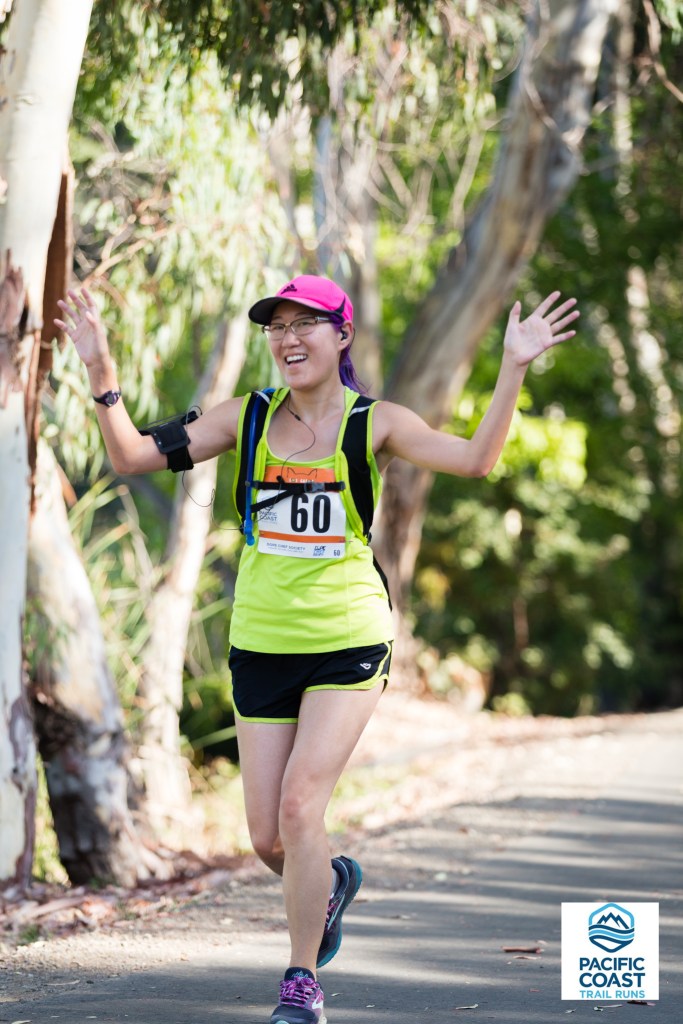
Running in a Pacific Coast Trail Run in 2018. I placed third in my division!


I announced to my husband and some close friends and confidants (whom have had to endure my emotional ups and downs this past year and I am intensely grateful to) before the Atlanta shooting that I was going to start running again starting Tuesday, March 16th. Tuesday at lunchtime I put on my trusty running shoes, my neon running gear (aside from helpfulness in not getting gear mixed up with other people’s the neon has always been my way of helping if I were to be attacked or killed and people needed to find me), my fancy new Bluetooth earbuds (I actually only ever wear one so I’m more aware of my surroundings as a lone female), and my running belt (which holds my phone, key and id). I hit the road and ran for the first time in months. I fell into a familiar cadence and rhythm, toe to heel, breathing just so, looking at the long distance. Was I weaker, slower, less conditioned, and less good than before? Absolutely. Did I feel bad about my backward slide? Absolutely. Did I run less mileage? Absolutely. I essentially ran only 3 miles in 30 minutes (unlike my typical longer distances and speeds). But, I felt so proud of myself for doing it. It felt like I was taking something back that I’d allowed myself to give up.

That late afternoon/early evening I started seeing posts coming though about the murder of 8 people, mostly Asian women, in my Asian community feeds. It was astounding. Everyone was upset, scared, and frustrated. Feelings of “it’s not just Covid or Trump, although both are major factors now…we’ve experienced racism for far longer and it needs to be talked about” were popping up everywhere. Women started coming forward about the experiences they’d had and do have that resonated with me. Asian women are the majority of victims in recent reported allegedly anti-Asian crimes. There was a mutual sentiment that someone having “a bad day” wasn’t a good enough reason to murder 8 people. Having a “sex addiction” and wanting to “remove temptation” was not just cause to target mostly Asian women.

The next day my Mom reached out to me to ask about me, to tell me how much she loves and cares and worries about me, and to ask me to please be as careful as I can. We both know there’s only so much I can do to stay safe… a lot of it really isn’t up to me. I can, however, be vigilant. My husband talked with me about please carrying mace and making sure to tell him my running routes in case the worst happens and he needs to search for me if I don’t come home.

I went running on Thursday.

This has gotten far longer and more self indulgent than I planned. I think my friend reaching out to me for comfort and to talk, an Asian woman to another, gave me the shove I needed to make some kind of public statement about the arguably anti-Asian racism and sexism that I’ve experienced and that are experienced by the greater community. Sorry for being wordy. It occurred to me that I felt better and cared about and heard, validated, supported when my mom reached out, when my husband talked with me, or even just seeing non-Asian friends post about the issues in the news on various social media outlets.

So, I wanted to write and share this post personally/self indulgently, but also in case it resonates with anyone else out there whom is or has been having a tough time. You’re not alone. I care about you. I hope you’re safe. I hope your family and friends are safe. Please be vigilant about protecting yourself both physically and emotionally. Please stand up for and protect those that need protecting. Sometimes people look like they have it together, but they don’t.

And, because I’m oversharing right now and I’m opinionated in general, Black Lives Matter. A lot of the things I and the AAPI community have experienced and are experiencing cannot be righted until Black Lives Matter. I believe this to be true. I hope you understand. If you support the AAPI community, but not the Black one, that’s not okay.

Thanks for reading if you’ve made it through all of this. Please take care of yourselves, everyone.

사랑해요. I love you. ❤

Categories
KAD Life Personal Update

KAD Life: Personal Update DNA Results

Today’s post is simply a personal KAD journey update. In a previous post (How To: Start a Birth Family Search) I mentioned an optional DNA step. While some adoptees and birth families choose not to use DNA in their searches, or to confirm relations after contact has been made, my birth mother and I did choose to pursue DNA confirmation. However, we waited to start until December 2020, multiple months into our growing relationship, and have been subsequently biting our nails and experiencing emotional fatigue as a result for the past 2.5/3 months. Our DNA testing process was lengthy and included a “redo” because samples didn’t work the first time around. Suffice it to say, the whole thing has been an ordeal. I stand behind what I said in my previous post about not waiting to do the DNA step if you can help it due to the emotional and time-related impact.

Well, good news, the wait’s over! As of March 8th, 2021 (4 days ago) I received word from my CHLSS-SW (state-side social worker) that ESWS had sent an update about the DNA results. ESWS said

“I got a call from DNA test company, and they said that they establish the paternal relationship.

I’m really happy to send this content.”

I have subsequently asked my CHLSSSW to please have ESWS share the actual results/paperwork with me. There’s no guarantee that I’ll be allowed to have any of this information due to things like Korean laws or rules of adoption agencies etc. That said, I’m hoping that I can obtain these records for my own gratification and record-keeping.

So, how am I feeling? I suppose a mix of things. Relief, because I’ve been framing my mind around us receiving negative results so as to theoretically reduce feelings of disappointment, hurt, sadness, loss. Weird… definitely feeling weird. For most people, the lifelong feeling of never knowing “who” you are or “where” you come from is likely different than it is for an orphan or otherwise abandoned person, especially one whom has never had any opportunity to “know” a genetic relative. I’ve gotten used to the idea of being a solo-flyer without the benefit of that “safety net” that everyone else seems to have (i.e. where you got your looks, many of your strengths/weaknesses, personality traits, allergies, disease susceptibility, blood type, whatever else comes with genetic knowledge). I guess I feel like I have the potential for learning these things that have been closed to me for my entire life, but that most people know as a matter of course. It’s weird and I don’t know what to make of it, or what to do with the information.

Outside of feeling relief, and a constant sense of “weirdness”, I am at a loss for what, if anything, it means for my birth family or for my “rights” in Korea. Does my birth mother care more about me now? Will the family be more willing to accept me with DNA proof than they already were? Will she tell my (half) sister about me, now? Will she, and the family, add me to their family registry (the only way an illegitimate person like myself, or any other KAD, is “recognized” as a legal/legitimate Korean person in South Korea)? What, if anything, does this mean?

I am looking at the photos that my birth mother has sent me through ESWS and CHLSS these past months through a different lens.

Before the DNA result, I was actively searching for any visual resemblance to try to legitimize and validate a sense of belonging and a biological relationship. When I’d first seen my birth mother’s photo I was disappointed. I didn’t feel that I looked like her and kept searching for definitive characteristics that matched. She’d commented that I looked a lot like my birth father (whom I have no information or rights to learn about in South Korea due to being “illegitimate”). So, I’d felt a bit of a sense of loss… like I was never going to actually know anyone that looked like me. Over the months, though, I found more visual resemblance in the photos of her and the extended family. One aunt in particular she, and my cousin, felt I could be the direct daughter of because of how similar we looked based on pictures. That felt good to hear, because I could see it too.

I felt like my birth mother, and my birth family, were acting similarly to me… searching for visual similarities in lieu of DNA proof. Every new physical detail or attribute we learned about each other that was similar was elevated in our minds. When my birth mother and I found out that we both had the same menstrual symptoms and history (South Korean women will talk about this, it’s considered normal in a maternal relationship), are the same height, same weight, and have similar skin and hair types it felt like a comfort and revelation. Still, it felt like we were trying to connect dots to try and reinforce broken or unformed ties.

Now, when I look at those photos, I’m certain that I am related. I’m not searching for “proof” to assuage lingering doubts or to try to build up my theoretical “where I come from” story. Rather, I’m looking for aspects of myself with a degree of certainty. I’m not sure if the distinction makes sense to those whom have not experienced what this is like. But, to me it’s a difference.

Anyway, I certainly have plenty more thoughts on the matter, but I feel like this is a good stopping point. I’m curious what other KADs have experienced in terms of “where do I come from” and genetic history. Of course, all comments are welcome regardless of KAD experience or not.

Thanks for reading!

사랑합니다! (I love you) ❤

Categories
KAD experience KAD Life

KAD Life: “Minari” and Relatable Asian-American Experiences

Recently the movie “Minari” (미나리 – meaning water dropwort) was released in the United States. It was directed by an American film director named Lee Isaac Chung (정이삭 – Cheong Ee Sak) whose family is from South Korea. It starred a mostly all Korean or Korean-American cast and was set in the early 1980s rural America. The film focuses on a Korean American family as they move to Arkansas to start a farm in search of the American dream. “Minari” is also a film about family and what “home” means.

Minari' Arkansas Premier at 112 Drive-In

Despite being financed and distributed by American companies, written and directed by an American film-maker, and focusing on the experience of an immigrant family in America, it was not allowed to participate in the Golden Globes for “best picture”. Rather, the film was classified as a “foreign film” (which it won the Golden Globe for).

As a KAD, the controversy and classification around “Minari” strikes homes. Additionally, the film itself is, in some ways, the embodiment of the KAD experience. While watching it I felt a profound sense of parallels in my own life, but also the diverging path of “not being really Korean” or “not being a real immigrant” in many ways.

I don’t want to spoil anything because this movie is not yet easily available for everyone. That said, whether or not you are KAD, Asian, Korean, an immigrant, or a mixture of all or none of those things… I recommend giving the film a watch should you have the opportunity.

I wrote a little social media post about my thoughts after watching “Minari”. I’ve essentially copy/pasted it below.

“저는 최근에 “미나리”를 봤어요. 저는 그것은 잘 좋았어요. 대중 매체나 문화에서 자주 볼 수 없는 많은 미국인들의 경험을 대변한다고 느꼈어요.

저는 많은 것을 공감할 수 있었어요. 특히, 교외나 시골, 백인의 아메리카에서 아시아인이 되는 것이에요. 아이들이 왜 그렇게 생겼는지, 왜 얼굴이 납작한지를 물었을 때, 나는 마음속으로 그것을 느꼈어요. 모니카가 미화되거나 이국적이거나 객관화된 모습을 보는 것이 제게 큰 영향을 미쳤어요. 저도 똑같은 대우를 받았어요. 성인 여성으로서 머리를 쓰다듬는 등 개인으로서의 진가와 경험, 힘을 해치는 ‘너무 귀엽다’는 말을 들었어요. 그런 경험들이 미국영화로 표현되는 것을 보고 슬프고 감사했어요.

하지만, 저는 한국 가정에서 자란 경험에 공감할 수 없었어요. 문화 간 기대, 언어 장벽, 그리고 제한된 직업 선택권을 탐구하는 것은 미국에서 이민자들이 경험하는 한 측면이에요. 그런 점에서 저는 이민자의 경험에서 특권을 받아왔습니다. 저는 고난을 알고 있지만 경험해 본 적은 없어요. 저는 그 영화의 그런 면을 높이 평가했어요.

이 영화가 규범과는 다른 미국 경험을 다룬 미국 영화임에도 불구하고 “최고의 외국 영화”를 수상했다는 것은 아쉽지만 놀라운 일은 아니에요.

“미나리”본 사람 있어요? 어떻게 생각했어요?
********
I recently watched “Minari.” I really liked it. I felt that it represents the experience of many Americans who are not often seen in mass media or pop culture.

I could relate to many things. Especially, what it is to be Asian in the suburbs, or rural areas, in “white” America. When the kids were asked why they looked weird and why their faces were flat, I felt it in my heart. Seeing Monica infantilized, exoticized, or otherwise objectified had a big impact on me. I have been, and am, treated the same way. As an adult woman, I’ve heard that “I’m/She’s so cute” or “a doll” or been treated in ways that minimalizes my personal value, experience, and strength. I’ve even had my head stroked by people as a grown woman. I was both saddened and grateful to see such experiences expressed in an American movie.

However, I couldn’t relate to the experience of growing up in a Korean family. Exploring cross-cultural expectations, language barriers, and limited career options is an aspect of immigrants’ experience in the United States. In that regard, I have been privileged from the experience of most immigrants. I know of the hardships, but I’ve never experienced them in the exact same way. I highly appreciated that aspect of the movie.

It’s unfortunate that this movie won the “Best Foreign Film” award even though it’s an American film about a different American experience than the norm, but it’s not surprising.

Has anyone seen “Minari”? What did you think?”

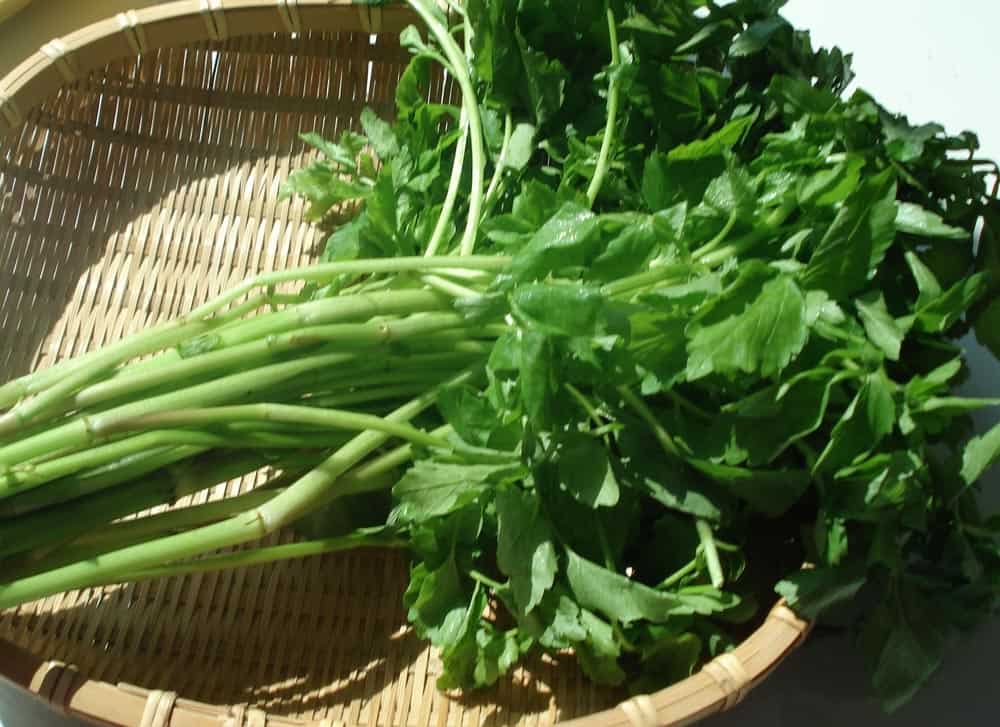
Water dropwort (Minari) - Korean cooking ingredients - Maangchi.com
Minari (미나리 – Water Dropwort): Image from Maangchi.com

Thanks for reading! I hope you’re all staying safe and as well as possible.

사랑해요. (I love you) ❤

Categories
KAD experience korean beauty

Korean Beauty: Western Culture and the KAD Experience

I remember my childhood-young adulthood growing up as an east-Asian girl, in suburban (and sometimes rural) mid-Western America, with a white family, white friends, and a white community, surrounded by 1980’s-early 2000’s mainstream pop-culture, which was also heavily white. There’s nothing inherently wrong with any of those things. That said, being one of the very few people I knew or saw that looked anything like myself meant being alone when it came to beauty. Finding “how I fit” during a time when many young, cis-gender females were going through their own journeys of beauty and self expression was made more difficult by not having role models, products, tutorials, or similar sorts of references to rely on.

I recall watching the women in my family put on makeup, curl their hair, groom themselves, and wear clothing that never worked on me. The colors were all wrong, applying eye makeup the way they did looked terrible on my monolids, my hair did not hold a curl well and looked rather odd on me, and I found that I didn’t need the types of deodorants or hair removal supplies that many of them did. Skincare products were not made for me and were often far too harsh, furthering breakouts. Eyelash curlers didn’t even fit my eyes or the planes of my face!

Childhood throwback: Grandma giving me a perm

Getting “make-overs” (whether by friends, family, or even paid beauticians) was often a bit bittersweet and awkward (although I never acted like I was bothered) as nobody knew what to do with me. Again, folks would try to do what worked for the norm (white girls and women) on me and it just didn’t work. Sometimes people would comment on how surprisingly long my eyelashes were because my “squinty eyes” hid that feature, how flat my face or nose was, how hairless I was, how thin and too straight my eyebrows were, and generally how unlike “most people” I looked.

Additionally, the number of times that people (including salespersons at stores) would focus on my body and make me feel unattractive or unwomanly was rather shocking in retrospect. I was called a “skinny mini”, a “doll”, a “child”, “flat”, and “not a real woman because I did not have curves” quite often. People still say these things to me as an adult, which is both surprising and unsurprising in a number of ways. Suffice it to say whether it was my face, my hair, or my body… I was not “normal” and people just didn’t know what to do with me!

Something that I’ve reflected on is the lack of mainstream prevalence of Asians in general, good or bad. In fact, if there was any representation at all it was often troublesome or flat out “bad” in how it impacted the way people saw Asians or how Asians, like myself, saw themselves. (As a note: I understand that these representations were reflections of the time and that many did not, and do not, think of these representations as negative given the historical context. I also understand that representation and racism are very complex issues, as are how people feel about said topics I am aware that some Asians, myself included, were just happy to see any representation at all regardless of theoretical good or bad because of how slim representation was in general).

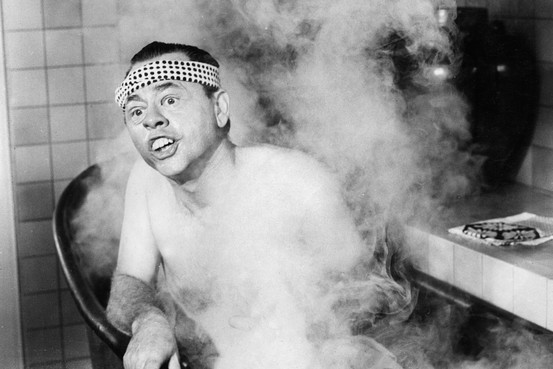
Mickey Rooney as Mr. Yunioshi in Breakfast at Tiffany’s


Sure, there was Mickey Rooney’s performance as Mr. Yunioshi in Breakfast at Tiffany’s in 1961, some fledgling televised Japanese anime starting in the late 1960s, Bruce Lee’s popularization of Kung Fu and arguably Chinese culture in the 1970s, David Bowie’s “China Girl” song released in 1983, the introduction of Thuy Trang (the “yellow ranger” in the Power Rangers TV show) in 1993, the appearance of Ally McBeal’s side-kick Ling Woo (played by Lucy Liu) in 1997, and the broadening of Japanese anime fan-culture in the 1990s-early 2000s. However, these examples tended to be dictated by, inherited by, represented by, or consumed by non-Asians. They also tended to exoticize, simplify or otherwise dis-empower Asians, especially Asian women.

David Bowie’s “China Girl” circa 1983

A mixture of all of these things made it very hard for me to feel good about myself, my looks, my status as a female or woman. Add to the equation that I didn’t have anywhere to turn to find products or styles that were made to work with someone like me. Furthermore, that people both focused on and completely invalidated my Asian-ness… . Growing up as an Asian person, and specifically as a KAD without anyone like myself to turn to, made for a lot of self doubt and awkwardness when I approached anything that dealt with beauty, grooming, or fashion for a significant period of my life.

All of this said, I am aware that I was certainly not alone in growing up as an “other” in the USA during that time. The issues that other minorities (racial, gender, body type, able-ness or other) faced with representation, and subsequent beauty, grooming, and fashion challenges, were just as real and with extensive complexities, hardships, and impact that I cannot speak to other than to acknowledge that my experience does not over-shadow, compare to, or take-away from their experiences. Additionally, I had the good fortune of being raised by a family (immediate family especially) that celebrated or at least acknowledged and supported my Asian-ness or Korean-ness, even if they did not have the parallel experiences to draw from. I know many KADs did not have the privilege I did in that regard.

Something that occasionally comes up in KAD channels is the additional feelings of other-ness amongst KADs that mixed-race and/or black KADs feel when talking about the experiences of their fully east-Asian/Korean peers. I think it’s something that we as KADs need to be more aware of. I hope to see our community work to make space for and amplify the voices of KADs with a mixed-race or black background. However, as this is my blog and I can only share the experience that I’ve personally had, I cannot speak to that particular cultural journey. If there is someone who reads this blog that can speak to that experience, I’d be more than happy to do a collab or dedicate a blog post specifically for you to share your thoughts.

So, this post ended up being a little serious. It’s also a tad long. I will be doing separate posts about Korean Beauty that address tangential topics from the globalization and popularization of Korean culture (K-pop, K-dramas, K-beauty, Hallyu 한류), what navigating Western and Korean beauty paradigms as a KAD is like, and even my own thoughts of fashion/beauty/grooming.

I hope that it was interesting perspective. My hope was to set a stage and share what my experiences were like. I also hope that this information helps to parameterize the future Korean Beauty posts that I’ll be making. I’d be curious if other KADs, or readers in general, have their own experiences to share navigating otherness while growing up in a Western (American or European) community.

As always, I love you. 사랑해요! ❤