Categories
KAD Life Personal Update

KAD Life: Personal Update DNA Results

Today’s post is simply a personal KAD journey update. In a previous post (How To: Start a Birth Family Search) I mentioned an optional DNA step. While some adoptees and birth families choose not to use DNA in their searches, or to confirm relations after contact has been made, my birth mother and I did choose to pursue DNA confirmation. However, we waited to start until December 2020, multiple months into our growing relationship, and have been subsequently biting our nails and experiencing emotional fatigue as a result for the past 2.5/3 months. Our DNA testing process was lengthy and included a “redo” because samples didn’t work the first time around. Suffice it to say, the whole thing has been an ordeal. I stand behind what I said in my previous post about not waiting to do the DNA step if you can help it due to the emotional and time-related impact.

Well, good news, the wait’s over! As of March 8th, 2021 (4 days ago) I received word from my CHLSS-SW (state-side social worker) that ESWS had sent an update about the DNA results. ESWS said

“I got a call from DNA test company, and they said that they establish the paternal relationship.

I’m really happy to send this content.”

I have subsequently asked my CHLSSSW to please have ESWS share the actual results/paperwork with me. There’s no guarantee that I’ll be allowed to have any of this information due to things like Korean laws or rules of adoption agencies etc. That said, I’m hoping that I can obtain these records for my own gratification and record-keeping.

So, how am I feeling? I suppose a mix of things. Relief, because I’ve been framing my mind around us receiving negative results so as to theoretically reduce feelings of disappointment, hurt, sadness, loss. Weird… definitely feeling weird. For most people, the lifelong feeling of never knowing “who” you are or “where” you come from is likely different than it is for an orphan or otherwise abandoned person, especially one whom has never had any opportunity to “know” a genetic relative. I’ve gotten used to the idea of being a solo-flyer without the benefit of that “safety net” that everyone else seems to have (i.e. where you got your looks, many of your strengths/weaknesses, personality traits, allergies, disease susceptibility, blood type, whatever else comes with genetic knowledge). I guess I feel like I have the potential for learning these things that have been closed to me for my entire life, but that most people know as a matter of course. It’s weird and I don’t know what to make of it, or what to do with the information.

Outside of feeling relief, and a constant sense of “weirdness”, I am at a loss for what, if anything, it means for my birth family or for my “rights” in Korea. Does my birth mother care more about me now? Will the family be more willing to accept me with DNA proof than they already were? Will she tell my (half) sister about me, now? Will she, and the family, add me to their family registry (the only way an illegitimate person like myself, or any other KAD, is “recognized” as a legal/legitimate Korean person in South Korea)? What, if anything, does this mean?

I am looking at the photos that my birth mother has sent me through ESWS and CHLSS these past months through a different lens.

Before the DNA result, I was actively searching for any visual resemblance to try to legitimize and validate a sense of belonging and a biological relationship. When I’d first seen my birth mother’s photo I was disappointed. I didn’t feel that I looked like her and kept searching for definitive characteristics that matched. She’d commented that I looked a lot like my birth father (whom I have no information or rights to learn about in South Korea due to being “illegitimate”). So, I’d felt a bit of a sense of loss… like I was never going to actually know anyone that looked like me. Over the months, though, I found more visual resemblance in the photos of her and the extended family. One aunt in particular she, and my cousin, felt I could be the direct daughter of because of how similar we looked based on pictures. That felt good to hear, because I could see it too.

I felt like my birth mother, and my birth family, were acting similarly to me… searching for visual similarities in lieu of DNA proof. Every new physical detail or attribute we learned about each other that was similar was elevated in our minds. When my birth mother and I found out that we both had the same menstrual symptoms and history (South Korean women will talk about this, it’s considered normal in a maternal relationship), are the same height, same weight, and have similar skin and hair types it felt like a comfort and revelation. Still, it felt like we were trying to connect dots to try and reinforce broken or unformed ties.

Now, when I look at those photos, I’m certain that I am related. I’m not searching for “proof” to assuage lingering doubts or to try to build up my theoretical “where I come from” story. Rather, I’m looking for aspects of myself with a degree of certainty. I’m not sure if the distinction makes sense to those whom have not experienced what this is like. But, to me it’s a difference.

Anyway, I certainly have plenty more thoughts on the matter, but I feel like this is a good stopping point. I’m curious what other KADs have experienced in terms of “where do I come from” and genetic history. Of course, all comments are welcome regardless of KAD experience or not.

Thanks for reading!

사랑합니다! (I love you) ❤

Categories
KAD experience korean beauty

Korean Beauty: Western Culture and the KAD Experience

I remember my childhood-young adulthood growing up as an east-Asian girl, in suburban (and sometimes rural) mid-Western America, with a white family, white friends, and a white community, surrounded by 1980’s-early 2000’s mainstream pop-culture, which was also heavily white. There’s nothing inherently wrong with any of those things. That said, being one of the very few people I knew or saw that looked anything like myself meant being alone when it came to beauty. Finding “how I fit” during a time when many young, cis-gender females were going through their own journeys of beauty and self expression was made more difficult by not having role models, products, tutorials, or similar sorts of references to rely on.

I recall watching the women in my family put on makeup, curl their hair, groom themselves, and wear clothing that never worked on me. The colors were all wrong, applying eye makeup the way they did looked terrible on my monolids, my hair did not hold a curl well and looked rather odd on me, and I found that I didn’t need the types of deodorants or hair removal supplies that many of them did. Skincare products were not made for me and were often far too harsh, furthering breakouts. Eyelash curlers didn’t even fit my eyes or the planes of my face!

Childhood throwback: Grandma giving me a perm

Getting “make-overs” (whether by friends, family, or even paid beauticians) was often a bit bittersweet and awkward (although I never acted like I was bothered) as nobody knew what to do with me. Again, folks would try to do what worked for the norm (white girls and women) on me and it just didn’t work. Sometimes people would comment on how surprisingly long my eyelashes were because my “squinty eyes” hid that feature, how flat my face or nose was, how hairless I was, how thin and too straight my eyebrows were, and generally how unlike “most people” I looked.

Additionally, the number of times that people (including salespersons at stores) would focus on my body and make me feel unattractive or unwomanly was rather shocking in retrospect. I was called a “skinny mini”, a “doll”, a “child”, “flat”, and “not a real woman because I did not have curves” quite often. People still say these things to me as an adult, which is both surprising and unsurprising in a number of ways. Suffice it to say whether it was my face, my hair, or my body… I was not “normal” and people just didn’t know what to do with me!

Something that I’ve reflected on is the lack of mainstream prevalence of Asians in general, good or bad. In fact, if there was any representation at all it was often troublesome or flat out “bad” in how it impacted the way people saw Asians or how Asians, like myself, saw themselves. (As a note: I understand that these representations were reflections of the time and that many did not, and do not, think of these representations as negative given the historical context. I also understand that representation and racism are very complex issues, as are how people feel about said topics I am aware that some Asians, myself included, were just happy to see any representation at all regardless of theoretical good or bad because of how slim representation was in general).

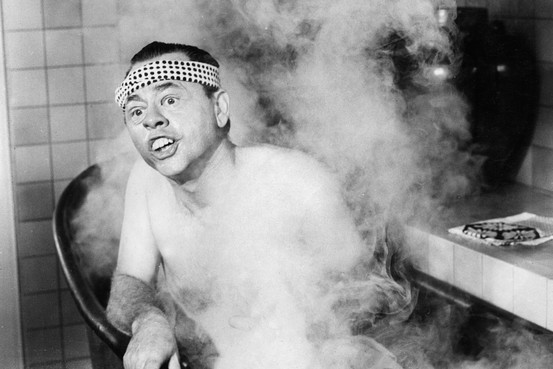
Mickey Rooney as Mr. Yunioshi in Breakfast at Tiffany’s


Sure, there was Mickey Rooney’s performance as Mr. Yunioshi in Breakfast at Tiffany’s in 1961, some fledgling televised Japanese anime starting in the late 1960s, Bruce Lee’s popularization of Kung Fu and arguably Chinese culture in the 1970s, David Bowie’s “China Girl” song released in 1983, the introduction of Thuy Trang (the “yellow ranger” in the Power Rangers TV show) in 1993, the appearance of Ally McBeal’s side-kick Ling Woo (played by Lucy Liu) in 1997, and the broadening of Japanese anime fan-culture in the 1990s-early 2000s. However, these examples tended to be dictated by, inherited by, represented by, or consumed by non-Asians. They also tended to exoticize, simplify or otherwise dis-empower Asians, especially Asian women.

David Bowie’s “China Girl” circa 1983

A mixture of all of these things made it very hard for me to feel good about myself, my looks, my status as a female or woman. Add to the equation that I didn’t have anywhere to turn to find products or styles that were made to work with someone like me. Furthermore, that people both focused on and completely invalidated my Asian-ness… . Growing up as an Asian person, and specifically as a KAD without anyone like myself to turn to, made for a lot of self doubt and awkwardness when I approached anything that dealt with beauty, grooming, or fashion for a significant period of my life.

All of this said, I am aware that I was certainly not alone in growing up as an “other” in the USA during that time. The issues that other minorities (racial, gender, body type, able-ness or other) faced with representation, and subsequent beauty, grooming, and fashion challenges, were just as real and with extensive complexities, hardships, and impact that I cannot speak to other than to acknowledge that my experience does not over-shadow, compare to, or take-away from their experiences. Additionally, I had the good fortune of being raised by a family (immediate family especially) that celebrated or at least acknowledged and supported my Asian-ness or Korean-ness, even if they did not have the parallel experiences to draw from. I know many KADs did not have the privilege I did in that regard.

Something that occasionally comes up in KAD channels is the additional feelings of other-ness amongst KADs that mixed-race and/or black KADs feel when talking about the experiences of their fully east-Asian/Korean peers. I think it’s something that we as KADs need to be more aware of. I hope to see our community work to make space for and amplify the voices of KADs with a mixed-race or black background. However, as this is my blog and I can only share the experience that I’ve personally had, I cannot speak to that particular cultural journey. If there is someone who reads this blog that can speak to that experience, I’d be more than happy to do a collab or dedicate a blog post specifically for you to share your thoughts.

So, this post ended up being a little serious. It’s also a tad long. I will be doing separate posts about Korean Beauty that address tangential topics from the globalization and popularization of Korean culture (K-pop, K-dramas, K-beauty, Hallyu 한류), what navigating Western and Korean beauty paradigms as a KAD is like, and even my own thoughts of fashion/beauty/grooming.

I hope that it was interesting perspective. My hope was to set a stage and share what my experiences were like. I also hope that this information helps to parameterize the future Korean Beauty posts that I’ll be making. I’d be curious if other KADs, or readers in general, have their own experiences to share navigating otherness while growing up in a Western (American or European) community.

As always, I love you. 사랑해요! ❤

Categories
cooking korean food

Korean Food: Making Kimchi

As mentioned in a previous blog post (“Korean Food: My Love Love Relationship”), I am a fan of Korean food. I like eating it, I like talking about it, and I like making it. I find that all of the above are especially meaningful to me as a way to explore and grow my connection to my Korean roots.

Spicy, fermented napa cabbage (commonly referred to as “kimchi” 김치) is arguably as Korean of a food as you can find. It is the national dish of both South and North Korea. It’s a staple of the Korean diet, coming in many varieties, and eaten numerous ways including by itself or as an essential ingredient in many soups and stews. Traditionally, kimchi was stored in large, earthenware, lidded pots (called “ong-gi” 옹기), often buried underground to prevent being frozen during cold months or to slow down the fermentation during warm months. Outside of the common napa cabbage version (actually “baechu-kimchi” 배추김치), there are hundreds of varieties of kimchi (the term itself referring to fermented vegetables). You could theoretically make kimchi out of just about any vegetable! The flavors and textures of each vary, and even the same variations of kimchi can look, smell, and taste differently depending on the maker, ingredients, age, and a number of other factors.

For this post, I’m going to specifically focus on sharing one of my experiences making baechu-kimchi. If you desire to make your own, there are numerous recipes online and in print. You could even find your own Korean friend (typically women were expected to make kimchi and many women over 50 continue this practice) and ask to join them in making kimchi. For ease, I’m going to include a few recommendations of recipes that I personally like for making napa cabbage kimchi (baechu-kimchi 배추김치) below. However, there are many recipes out there, so please explore on your own and find some that you like!

List of Napa Cabbage Kimchi Recipes (in no particular order):
1) https://www.maangchi.com/recipe/tongbaechu-kimchi
2) https://www.koreanbapsang.com/baechu-kimchi-napa-cabbage-kimchi/
3) http://crazykoreancooking.com/recipe/kimchi-spicy-pickled-cabbage

As a note, before you start making your own kimchi I highly suggest putting your hair up/back if you have long hair and wearing a pair of good rubber gloves!

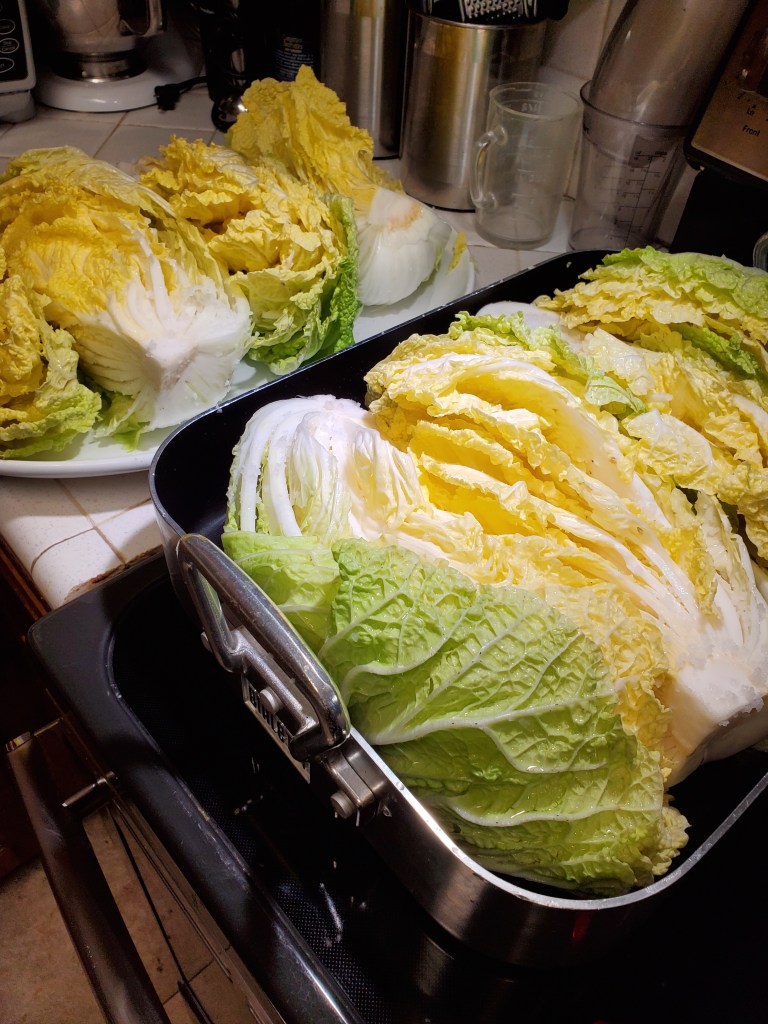
Early Stage: Halving and salting napa cabbage!
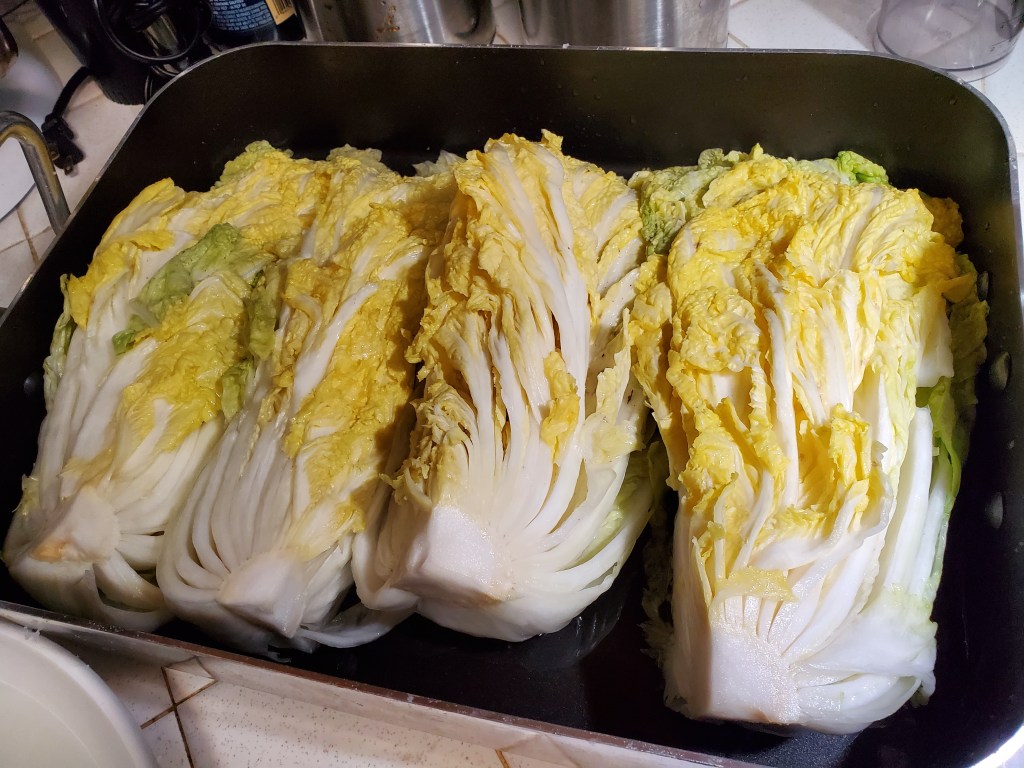
Early Stage: Napa cabbage in the process of brining
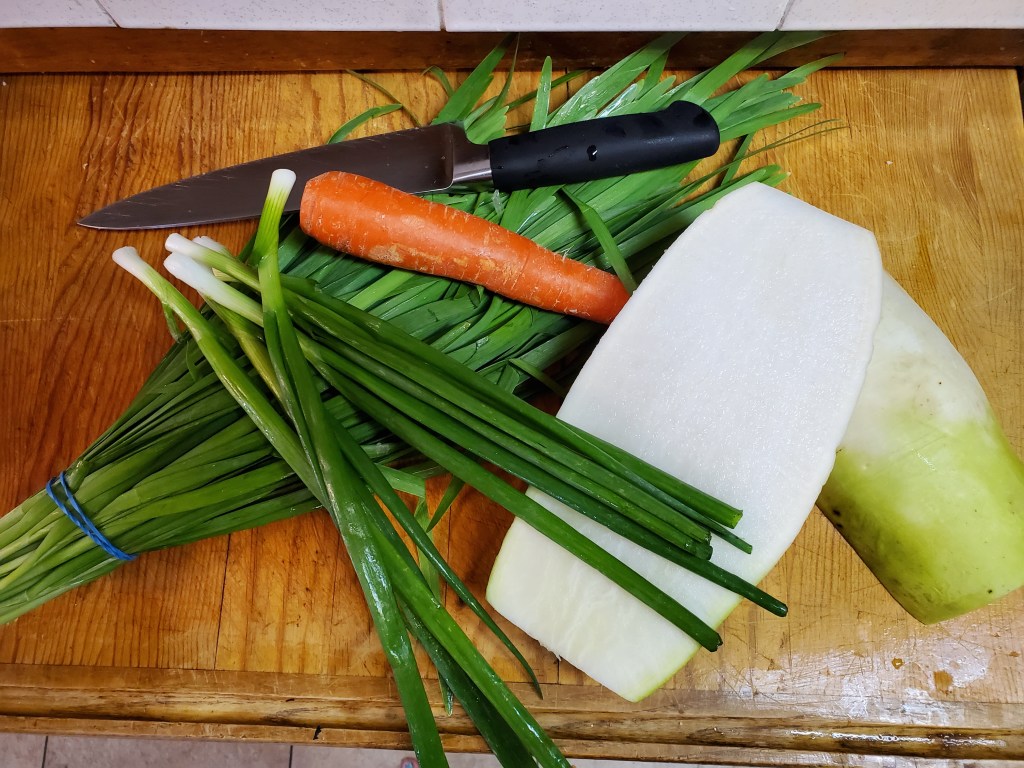
Early Stage: Chopping and slicing additional fresh ingredients (pictured here: radish, green onion, scallion, carrot)
Medium Stage: Brined napa cabbage
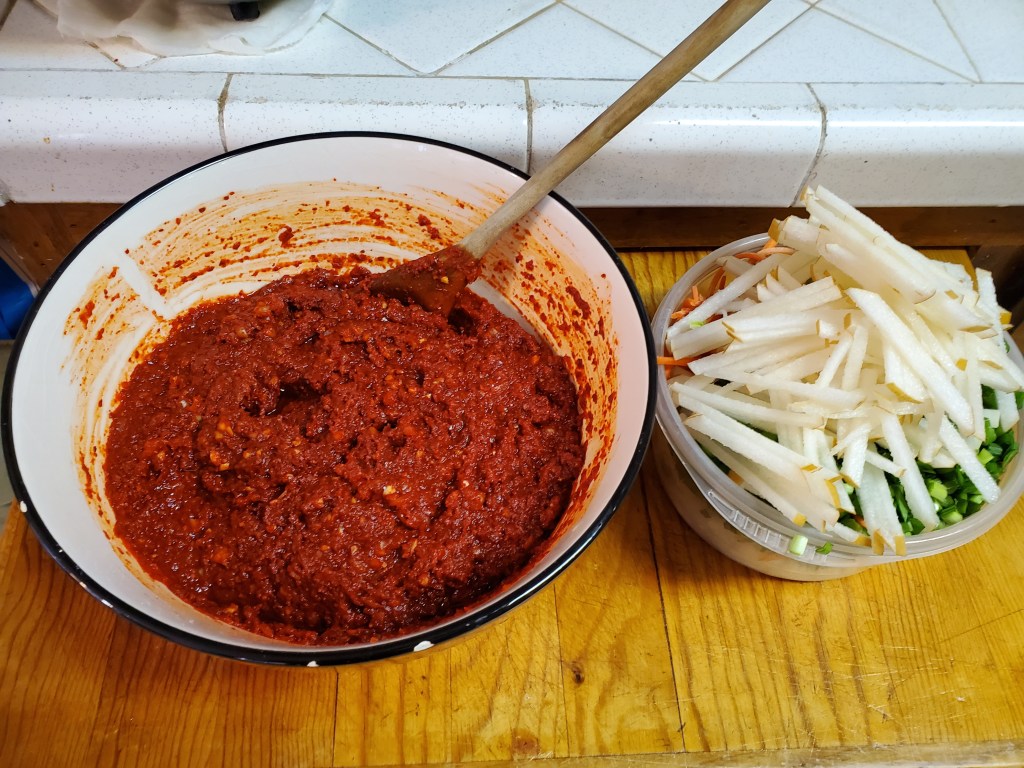
Medium Stage: Additional vegetables and chili paste complete
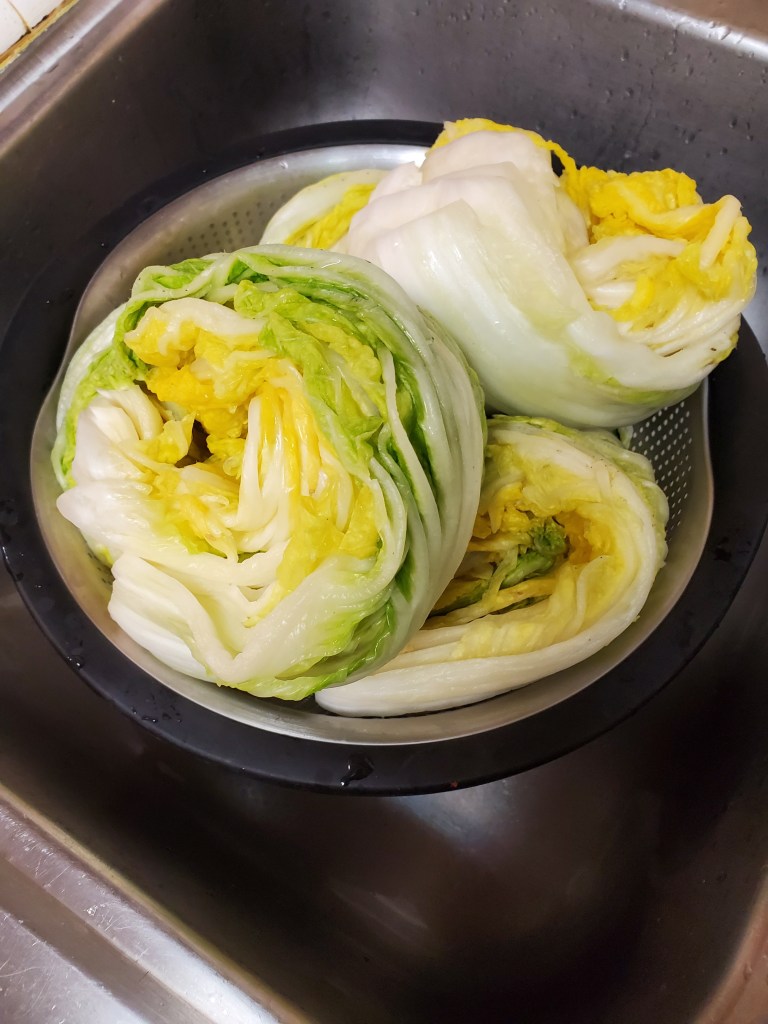
Medium Stage: Rinse, and drain your brined napa cabbage
End Stage: Apply the extra ingredients to your napa cabbage
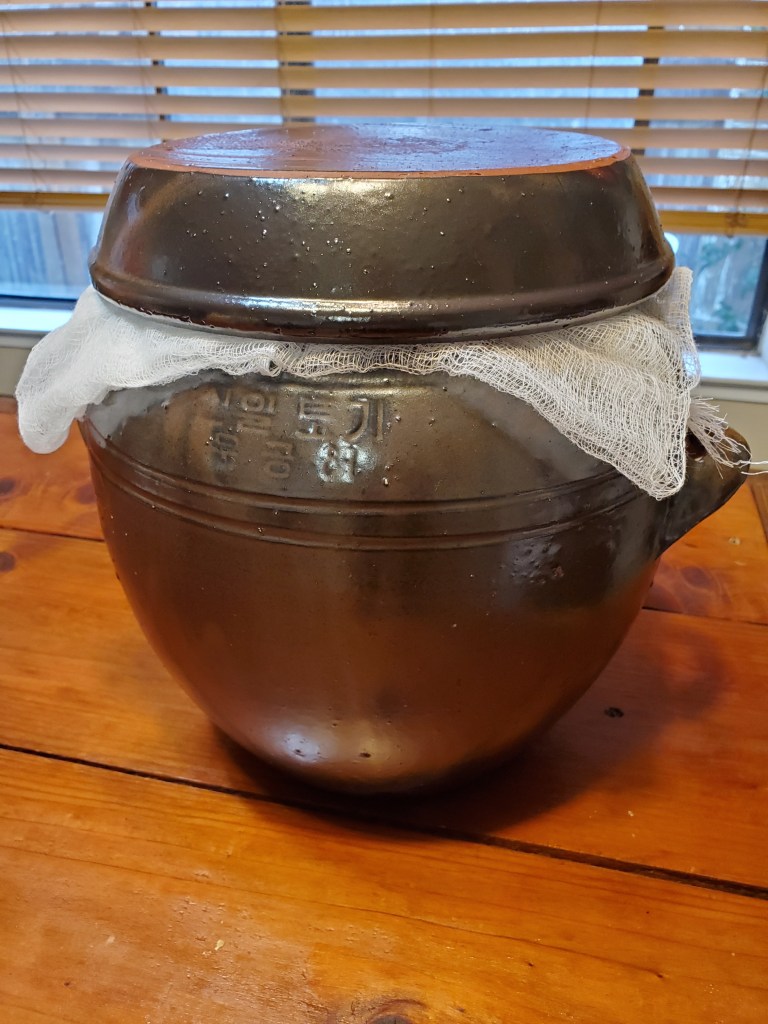
End Stage: Stack your baechu-kimchi rolls in a container (pictured here: my onggi)
End Stage: Cover and let the fermentation process begin

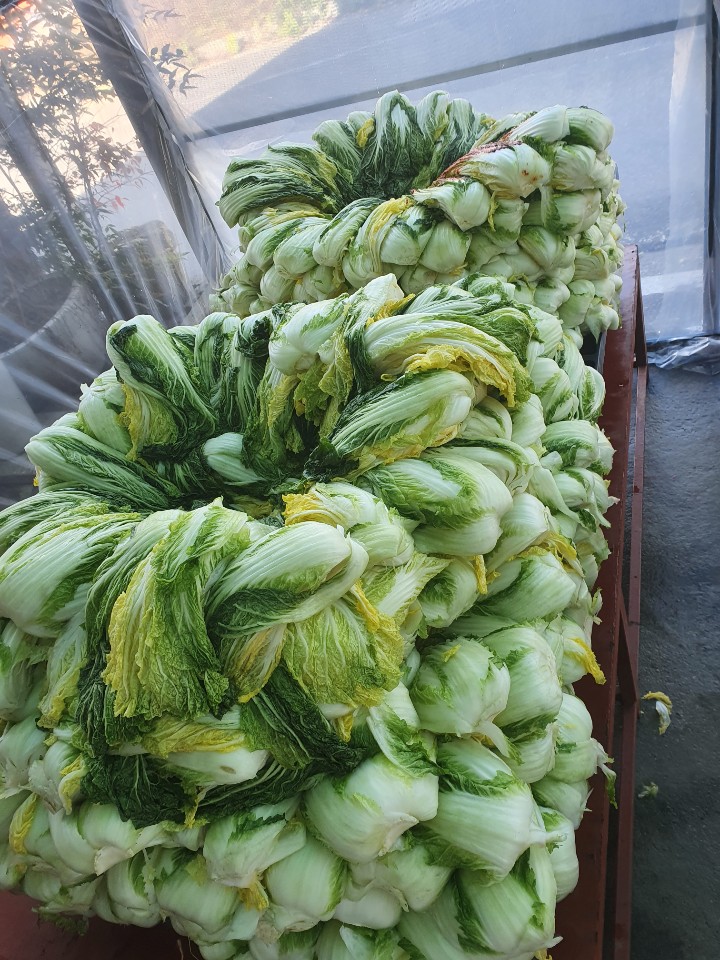
As a little added bonus to this post, there is a specific event in the winter called Gimjang (김장). Gimjang is the traditional process of preparing and storing kimchi for the winter. Gimjang yields large quantities of kimchi as it was meant to provide food throughout the winter. Often it is a highly labor-intensive task that communities participate in, families, extended relatives, neighbors. This past winter, my 엄마 (eom-ma meaning mom, in this case my birth/bio mom) sent me photos of my bio-family’s gimjang.

Napa cabbage for gimjang
Paste/sauce for kimchi
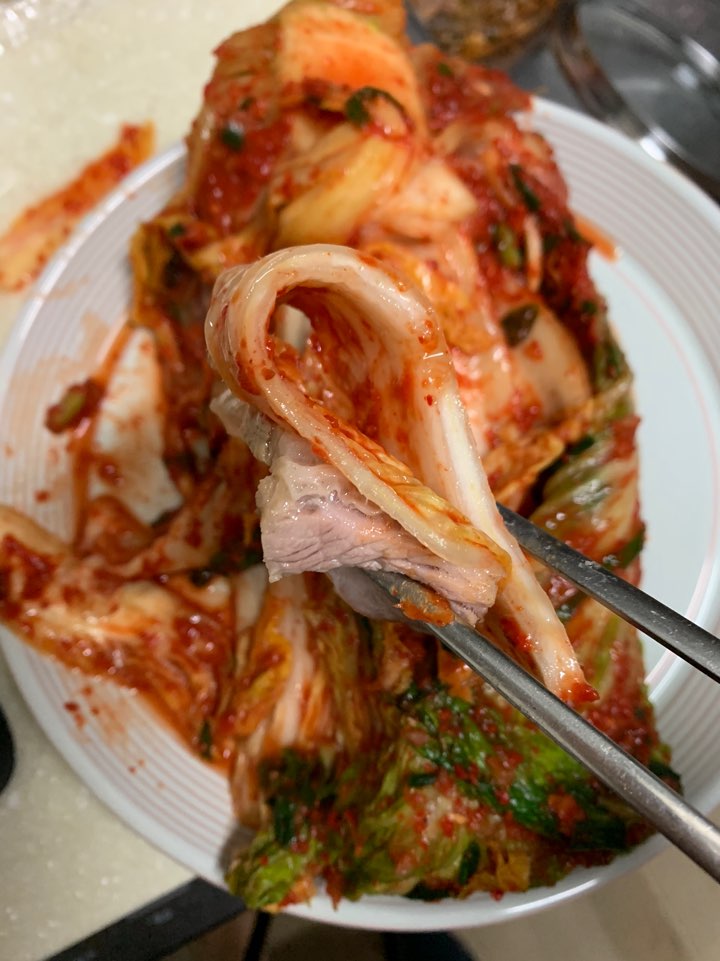
They ate pork suyuk, kimchi, and drank makgeolli during gimjang! Delicious!

Anyway, I hope that you enjoyed this post about making traditional, napa cabbage kimchi! I love 배추 김치 and highly recommend giving it a try if you have never eaten it before. Additional points if you decide you’d like to try making it yourself! It’s an interesting process, yields delicious results, and, to me anyway, helps me to feel closer to Korea and being Korean.

사랑해요! (I love you)! ❤